
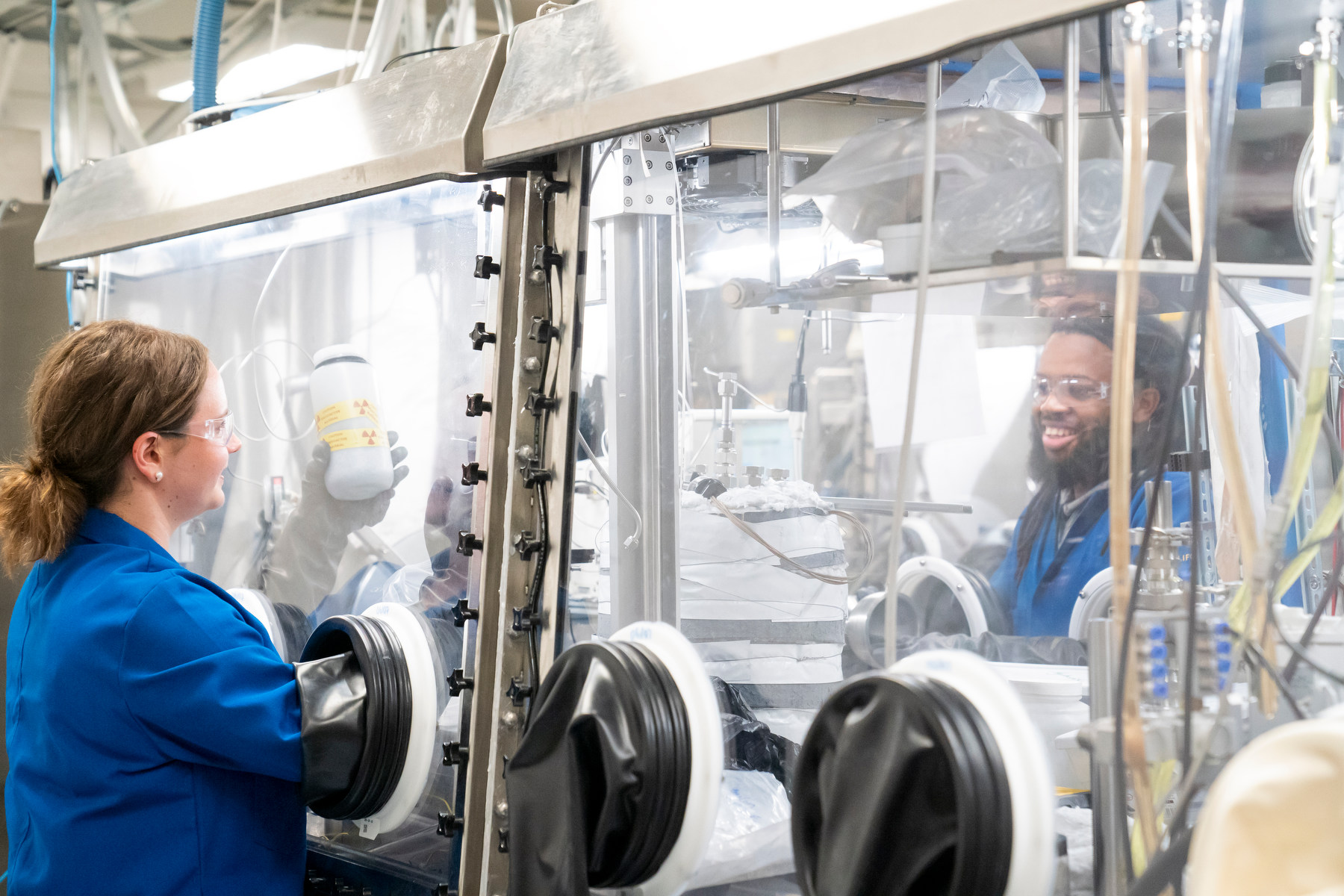
 Nuclear engineering graduate students Sasha Kennedy and Nathanael Gardner, from left, work with molten salt in professor Raluca Scarlat's lab. (Photo by Adam Lau/Berkeley Engineering)
Materials Science & Engineering and Nuclear Engineering
In this section
To engineer materials that can perform in the most demanding environments, you’ll need a foundation across disciplines. In the Materials Science and Engineering/Nuclear Engineering Joint Major, you’ll combine expertise in advanced materials with nuclear engineering to understand, design and optimize materials used in reactors and related extreme environments.
Contact
Engineering Student Services
120 Grimes Engineering Center
Berkeley, CA 94720
(510) 642-7594
ess@berkeley.edu
Through a strong foundation in both disciplines, you’ll learn how materials respond to heat, radiation, stress and other demanding conditions — knowledge essential for developing safer, more efficient energy systems and next-generation technologies. Graduates are well prepared for careers in the energy sector, as well as for graduate study and research at the forefront of materials and nuclear engineering.
The joint major programs are designed for students who wish to undertake study in two areas of engineering in order to qualify for employment in either field or for positions in which competence in two fields is required. These curricula include the core courses in each of the major fields. While they require slightly increased course loads, they can be completed in four years. Both majors are shown on the student’s transcript of record.
Want to know more? Check out the individual degree programs for Materials Science and Engineering and Nuclear Engineering.


Degree worksheets
The easiest, most convenient way to track your progress toward your degree requirements is to use a degree worksheet, with guidelines specific to your year of admission. You should bring your worksheet with you whenever you meet with your Engineering Student Services or faculty adviser. From your ‘My Academics’ page on CalCentral, use the ‘Semesters’ section to help complete your worksheet. When available, you can also use the Academic Progress Report to help update your degree worksheet.
Current degree worksheet: 2026
Past worksheets: 2019 | 2020 | 2021 | 2022 | 2023 | 2024 | 2025 | 2026
Engineering Student Services
120 Grimes Engineering Center
Berkeley, CA 94720
ess@berkeley.edu
(510) 642-7594
Degree requirements
Undergraduate programs and degree worksheets from previous years are available through the Undergraduate Guide archive.
| Course | Fall | Spring |
|---|---|---|
| Freshman Year | ||
| CHEM 1A+1AL – General Chemistry, or CHEM 4A – General Chemistry and Quantitative Analysis1 |
5
|
–
|
| ENGIN 7 – Introduction to Computer Programming and Numerical Methods |
–
|
4
|
| MATH 51 – Calculus I |
4
|
–
|
| MATH 52 – Calculus II |
–
|
4
|
| PHYSICS 7A – Physics for Scientists and Engineers |
–
|
4
|
| Reading & Composition Part A Course2 |
4
|
–
|
| Reading & Composition Part B Course2 |
–
|
4
|
| Humanities/Social Science Course2 |
3-4
|
–
|
| Total |
16-17
|
16
|
| Sophomore Year | ||
| MATSCI 45 – Properties of Materials + MATSCI 45L – Properties of Materials Laboratory |
4
|
–
|
| MATH 53 – Multivariable Calculus |
4
|
–
|
| MATH 54 – Linear Algebra and Differential Equations |
–
|
4
|
| MECENG C85 – Introduction to Solid Mechanics |
–
|
3
|
| PHYSICS 7B – Physics for Scientists and Engineers |
4
|
–
|
| PHYSICS 7C – Physics for Scientists and Engineers |
–
|
4
|
| Humanities/Social Science Courses2 |
3-4
|
3-4
|
| Total |
15-16
|
14-15
|
| Junior Year | ||
| ENGIN 40 – Engineering Thermodynamics |
4
|
–
|
| MATSCI 102 – Bonding Crystallography and Crystal Defects |
3
|
–
|
| MATSCI 103 – Phase Transformation and Kinetics |
–
|
3
|
| MATSCI 104 – Materials Characterization + MATSCI 104L – Materials Characterization Laboratory |
–
|
4
|
| NUCENG 100 – Introduction to Nuclear Engineering | 3 | – |
| NUCENG 101 – Nuclear Reactions and Radiation |
4
|
–
|
| NUCENG 104 – Radiation Detection and Nuclear Instrumentation Laboratory |
–
|
4
|
| NUCENG 150 – Introduction to Nuclear Reactor Theory |
–
|
4
|
| Technical Elective3 |
3
|
–
|
| Humanities/Social Science Course from Ethics List2,4 |
–
|
3-4
|
| Total |
17
|
18-19
|
| Senior Year | ||
| MATSCI 111 – Properties of Electronic Materials |
–
|
4
|
| MATSCI 113 – Mechanical Behavior of Materials |
–
|
3
|
| MATSCI 131 – Additive Manufacturing Processes and Systems for Advanced Materials |
3
|
–
|
| NUCENG 120 – Nuclear Materials |
4
|
–
|
| NUCENG 170A – Nuclear Design: Design in Nuclear Power Technology and Instrumentation |
–
|
3
|
| Materials Processing and Lifecycle Elective5 | ||
| Technical Electives3 |
10
|
3
|
| Total |
17
|
16
|
1CHEM 4A is intended for students majoring in chemistry or a closely related field.
2The Humanities/Social Sciences (H/SS) requirement includes two approved Reading & Composition (R&C) courses and four additional approved courses, with which a number of specific conditions must be satisfied. R&C courses must be taken for a letter grade (C- or better required). The first half (R&C Part A) must be completed by the end of the freshman year; the second half (R&C Part B) must be completed by no later than the end of the sophomore year. The remaining courses may be taken at any time during the program. See engineering.berkeley.edu/hss for complete details and a list of approved courses.
3Students must complete 16 units of upper division technical electives which must include at least 9 units of upper division nuclear engineering courses and at least 3 units from the Materials Processing and Lifecycle Elective list. The additional 4 units of upper division technical electives must be chosen in consultation with a faculty adviser. Technical electives cannot include any course taken on a P/NP basis; any course that counts as H/SS; BIOENG 100, 153; COMPSCI 194-100; DESINV courses (except DESINV 190E); ENGIN 125, 157AC, 170 series, 180, 183 series, 184, 185, 187, 188, 195 series; INDENG 185, 186, 190 series, 191, 192, 195; MECENG 190K, 191K. Students may receive up to 3 units of technical elective credit for graded research in MATSCI H194 or NUCENG H194.
4Students must take one course with ethics content. This may be fulfilled within the Humanities/Social Science (H/SS) requirement by taking one of the following courses: ANTHRO 156B; BIOENG 100; ENGIN 125, 157AC, 185; ESPM 161, 162; GEOG 31; IAS 157AC; ISF 100E; L&S 160B; PHILOS 2, 104, 107; SOCIOL 116.
5For the Materials Processing and Lifecycle Elective, please choose one course from the following: MATSCI 112, 118, 120, 121, 122, 123, 125, 128, 129, 136, or 159.
* A minimum of 120 units is required for graduation.
If you would like to receive these documents in an alternative, accessible format, please contact eng-ada@berkeley.edu.