• Skip to main content
  • Skip to primary navigation
  • Departments
    • Bioengineering
    • Civil and Environmental Engineering
    • Electrical Engineering and Computer Sciences
    • Industrial Engineering and Operations Research
    • Materials Science and Engineering
    • Mechanical Engineering
    • Nuclear Engineering
    • Aerospace program
    • Engineering Science program
  • News
    • Berkeley Engineer magazine
    • Social media
    • News videos
    • News digest (email)
    • Brand & Press kit
  • Events
    • Cal Day
    • Commencement
    • Events calendar
    • Homecoming
    • Kuh Lecture Series
    • Minner Lecture
    • Space reservations
    • View from the Top
  • College directory
  • For staff & faculty
Berkeley Engineering

Educating leaders. Creating knowledge. Serving society.

  • About
    • Facts & figures
    • Rankings
    • Mission & values
    • Equity & inclusion
    • Voices of Berkeley Engineering
    • Leadership team
    • Milestones
    • Buildings & facilities
    • Maps
  • Admissions
    • Undergraduate admissions
    • Graduate admissions
    • New students
    • Visit
    • Maps
    • Admissions events
    • K-12 outreach
  • Academics
    • Undergraduate programs
    • Majors & minors
    • Undergraduate Guide
    • Graduate programs
    • Graduate Guide
    • Innovation & entrepreneurship
    • Kresge Engineering Library
    • International programs
    • Executive education
  • Students
    • New students
    • Advising & counseling
    • ESS programs
    • CAEE academic support
    • Grad student services
    • Student life
    • Wellness & inclusion
    • Undergraduate Guide
    • > Degree requirements
    • > Policies & procedures
    • Forms & petitions
    • Resources
  • Research & faculty
    • Centers & institutes
    • Undergrad research
    • Faculty
    • Sustainability and resiliency
  • Connect
    • Alumni
    • Industry
    • Give
    • Stay in touch
  • Undergraduate programs
    • Aerospace Engineering
    • Bioengineering
    • Civil Engineering
    • Electrical Engineering & Computer Sciences
    • Engineering Science
    • Industrial Engineering & Operations Research
    • Materials Science & Engineering
    • Mechanical Engineering
    • Nuclear Engineering
    • Undeclared
  • Majors & minors
    • Major options
    • Minors
    • Change of major
  • Undergraduate Guide
  • Graduate programs
    • Professional master’s programs
    • MBA/MEng
  • Graduate Guide
  • Innovation & entrepreneurship
  • Kresge Engineering Library
  • International programs
    • GLOBE
    • Study abroad
  • Executive education
Home > Academics > Undergraduate programs > Environmental Engineering
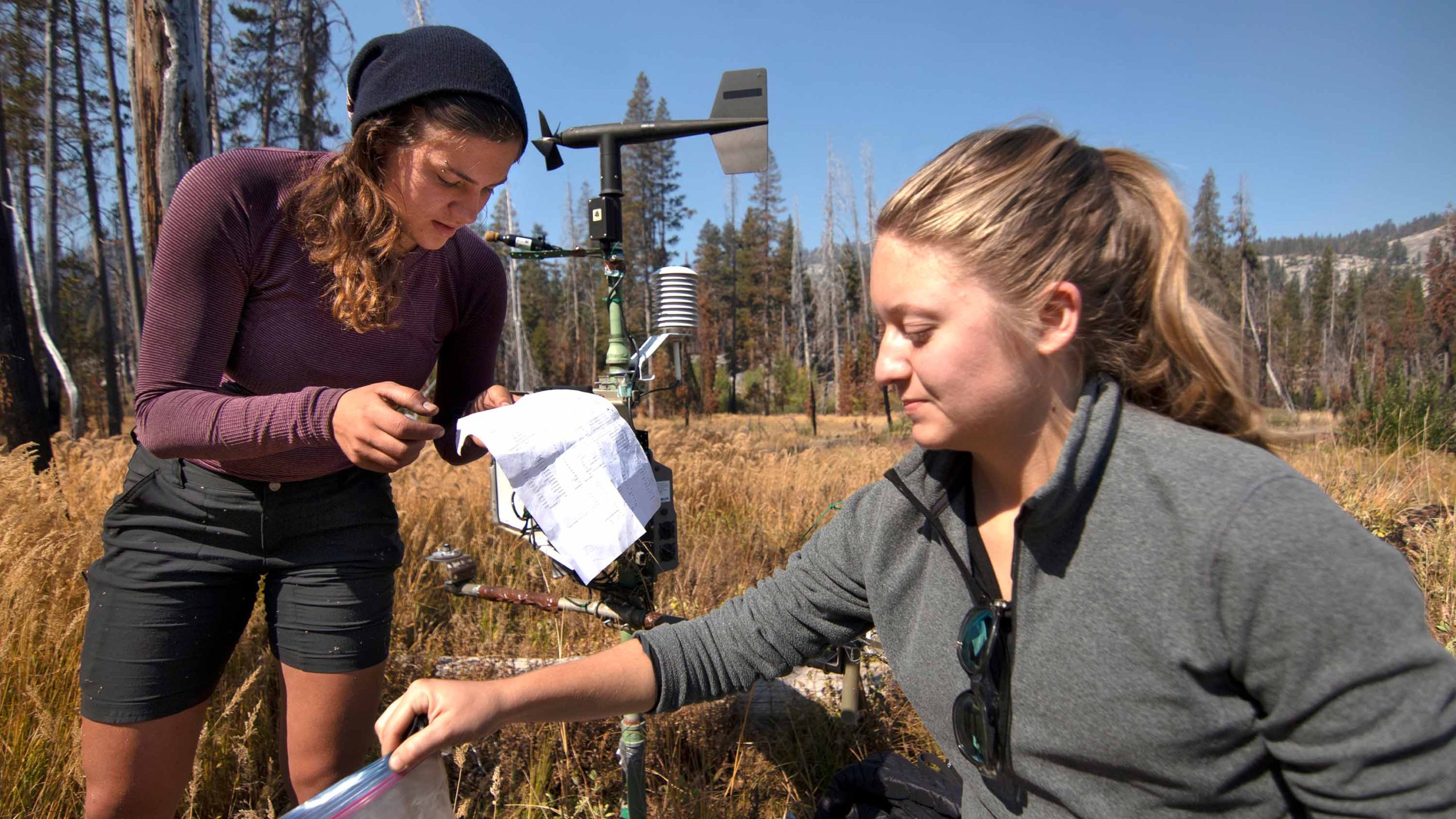
Students study fire-water interactions in YosemiteEnvironmental engineering graduate students conduct research on fire-water interactions in Yosemite National Park. (Photo by Adam Lau / Berkeley Engineering)

Environmental Engineering

  • Overview
  • Degree requirement
  • Degree worksheets

Are you passionate about protecting people and the planet? A degree in environmental engineering can equip you with the knowledge and skills to make a lasting impact. Environmental engineers tackle some of today’s most important challenges by improving air quality, ensuring access to safe drinking water, developing sustainable waste management systems and restoring contaminated land and water. Through innovative engineering solutions, they help create healthier communities and a more sustainable future. Environmental engineers might work in private industry, for government agencies or in a non-governmental, nonprofit organization.

Why choose Berkeley?

Contact

Department of Civil & Environmental Engineering
760 Davis Hall # 1710
Berkeley, CA 94720-1710
(510) 642-3261
support@ce.berkeley.edu

Our environmental engineering program is consistently ranked among the top in the nation by U.S. News & World Report. As an environmental engineering undergrad, you’ll get rigorous academic learning with an emphasis on environmental topics. Our classes are relatively small, so you’ll get to know both your professors and your fellow students. Undergraduates also have plenty of opportunities to engage in research with faculty, whose work covers air quality engineering, environmental fluid mechanics, hydrology and water quality engineering.

Interested? Learn more about the Department of Civil and Environmental Engineering. You can also explore a comparison chart to see how civil and environmental engineering majors differ in their focus.
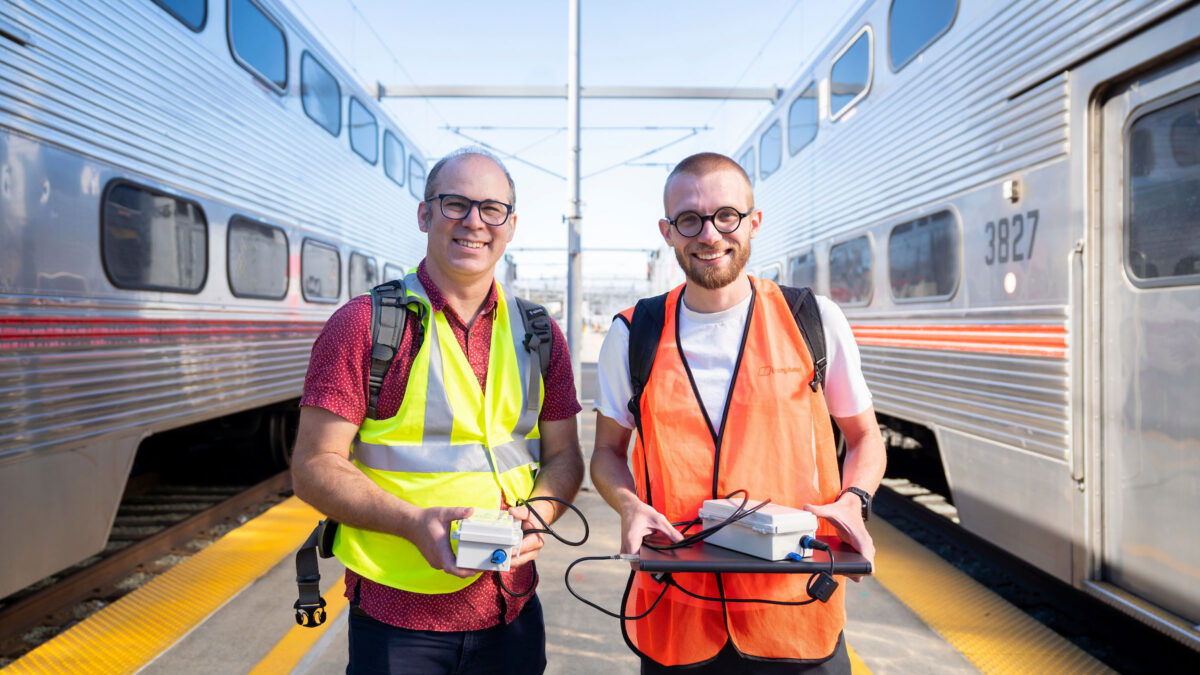
Civil and environmental engineering professor Joshua Apte and postdoc Sam Cliff take air quality measurements aboard diesel trains, which are in the process of being replaced by new electric trains at San Francisco Caltrain Station.

Electric trains quieter, more reliable — and healthier, study finds

Roman statues surrounding a pool.

Researchers shed new light on ancient concrete’s extraordinary durability

Engineering Student Services
120 Grimes Engineering Center
Berkeley, CA 94720
ess@berkeley.edu
(510) 642-7594

Department Contacts

Degree worksheet:  2026

Undergraduate programs and degree worksheets from previous years are available through the Undergraduate Guide archive.

Course Fall Spring
Freshman Year
CHEM 1A+1AL – General Chemistry
5
–
BIOLOGY 1B – General Biology Lecture
4
DATA C8 – Foundations of Data Science
4
MATH 51 – Calculus I
4
–
MATH 52 – Calculus II
–
4
PHYSICS 7A – Physics for Scientists and Engineers
–
4
Reading & Composition Part A Course1 4
Total
13
15
Sophomore Year
CIVENG 11 – Engineered Systems and Sustainability 3
CIVENG 70 – Engineering Geology 3
CIVENG 93 – Engineering Data Analysis 3
ENGIN 7 – Introduction to Computer Programming and Numerical Methods 4
MATH 53 – Multivariable Calculus
4
–
MATH 54 – Linear Algebra and Differential Equations
–
4
Basic Science Elective2 3-4
Reading & Composition Part B Course1 4
Total
14
14-15
Junior Year
CIVENG 100 – Elementary Fluid Mechanics 4
CIVENG C106 – Air Pollution 3
CIVENG 111 – Environmental Engineering 3
CIVENG 111L – Water and Air Quality Laboratory 1
Climate Change Elective3 3
Environmental Justice Elective4 3-4
Upper Division Technical Elective5 3-4
Humanities/Social Sciences Course1 3-4 3-4
Total
14-16
12-14
Senior Year
CIVENG C103N – Terrestrial Hydrology 4
CIVENG 115 – Water Chemistry 3
Geotechnical Elective6 3
Capstone Design Requirement7 3
Project Management / Environmental Policy Elective8 3-4
Upper Division Technical Elective5 3
Environmental Humanities1 3-4
Humanities/Social Sciences Course1 3-4
Total
13-15
12-13
  Notes

Please note that upper division Civil Engineering courses are only offered once a year.

* A minimum of 120 units is required for graduation.

1The Humanities/Social Sciences (H/SS) requirement includes two approved Reading & Composition (R&C) courses and four additional approved courses, with which a number of specific conditions must be satisfied. R&C courses must be taken for a letter grade (C- or better required). The first half (R&C Part A) must be completed by the end of the freshman year; the second half (R&C Part B) must be completed by no later than the end of the sophomore year. The remaining courses may be taken at any time during the program. See humanities and social sciences for complete details and a list of approved courses.

Additionally, one of the H/SS courses must be from the Environmental Humanities list.  This is the only major requirement that can be taken for pass/not pass.

2 To complete the Basic Science requirement, complete one course from the following:  CHEM 1B, CHEM 3A, PHYSICS 7B, or MECENG 40.

3To develop literacy and understanding of climate change and its impacts, complete one course from the following:  CIVENG 107, CIVENG 108, or CIVENG 110.

4To complete this major’s Environmental Justice requirement, complete one course from the following:  CIVENG 119 or ENGIN 157AC.

5To complete your Upper Division Technical Elective requirement, complete two courses from this list.

6To complete your Geotechnical Elective requirement, complete one course from the following:  CIVENG 170A, 171, 173, 175, 176, and 188.

7To complete your Capstone requirement, complete one course from the following:  CIVENG 105, CIVENG 112, or CIVENG 186.

8To complete your Project Management / Environmental Policy requirement, complete one course from this list.

     
Course Fall Spring
1st and 2nd Semesters
CIVENG 11 – Engineered Systems and Sustainability
3
CIVENG 70 – Engineering Geology 3
CIVENG 93 – Engineering Data Analysis 3
CIVENG C106 – Air Pollution  3
CIVENG 111 – Environmental Engineering 3
CIVENG 111L – Water and Air Quality Laboratory 1
DATA C8 – Foundations of Data Science
4
Environmental Justice Elective2 3-4
Environmental Humanities1 3-4
Total 14
12-14
3rd and 4th Semesters
CIVENG 100 – Elementary Fluid Mechanics 4
CIVENG C103N – Terrestrial Hydrology 4
CIVENG 115 – Water Chemistry 3
ENGIN 7 – Introduction to Computer Programming and Numerical Methods 4
Climate Change Elective3 3
Geotechnical Elective4 3
Upper Division Technical Elective5 3
Humanities/Social Sciences Course1 3-4
Total
15
12-13
5th Semester**
Project Management / Environmental Policy Elective6  3-4
Capstone Design Requirement7 3
Upper Division Technical Elective5 3
Free Elective 3
Total
12
Notes

Please note that upper division Civil Engineering courses are only offered once a year.

* A minimum of 120 units is required for graduation.

1The Humanities/Social Sciences (H/SS) requirement includes two approved Reading & Composition (R&C) courses and four additional approved courses, with which a number of specific conditions must be satisfied. R&C courses must be taken for a letter grade (C- or better required). The first half (R&C Part A) must be completed by the end of the freshman year; the second half (R&C Part B) must be completed by no later than the end of the sophomore year. The remaining courses may be taken at any time during the program. See humanities and social sciences for complete details and a list of approved courses.

Additionally, one of the H/SS courses must be from the Environmental Humanities list.  This is the only major requirement that can be taken for pass/not pass.

2To complete this major’s Environmental Justice requirement, complete one course from the following:  CIVENG 119 or ENGIN 157AC.

3To develop literacy and understanding of climate change and its impacts, complete one course from the following:  CIVENG 107, CIVENG 108, or CIVENG 110.

4To complete your Geotechnical Elective requirement, complete one course from the following:  CIVENG 170A, 171, 173, 175, 176, and 188.

5To complete your Upper Division Technical Elective requirement, complete two courses from this list.

6To complete your Project Management / Environmental Policy requirement, complete one course from this list.

7To complete your Capstone requirement, complete one course from the following:  CIVENG 105, CIVENG 112, or CIVENG 186.


The easiest, most convenient way to track your progress toward your degree requirements is to use a degree worksheet, with guidelines specific to your year of admission. You should bring your worksheet with you whenever you meet with your Engineering Student Services or faculty adviser. From your ‘My Academics’ page on CalCentral, use the ‘Semesters’ section to help complete your worksheet. When available, you can also use the Academic Progress Report to help update your degree worksheet.

Environmental Engineering:  2025 | 2026

If you would like to receive these documents in an alternative, accessible format, please contact eng-ada@berkeley.edu.

  • Contact
  • Give
  • Privacy
  • UC Berkeley
  • Accessibility
  • Nondiscrimination
  • instagram
  • X logo
  • linkedin
  • facebook
  • youtube
  • bluesky
© 2026 UC Regents