
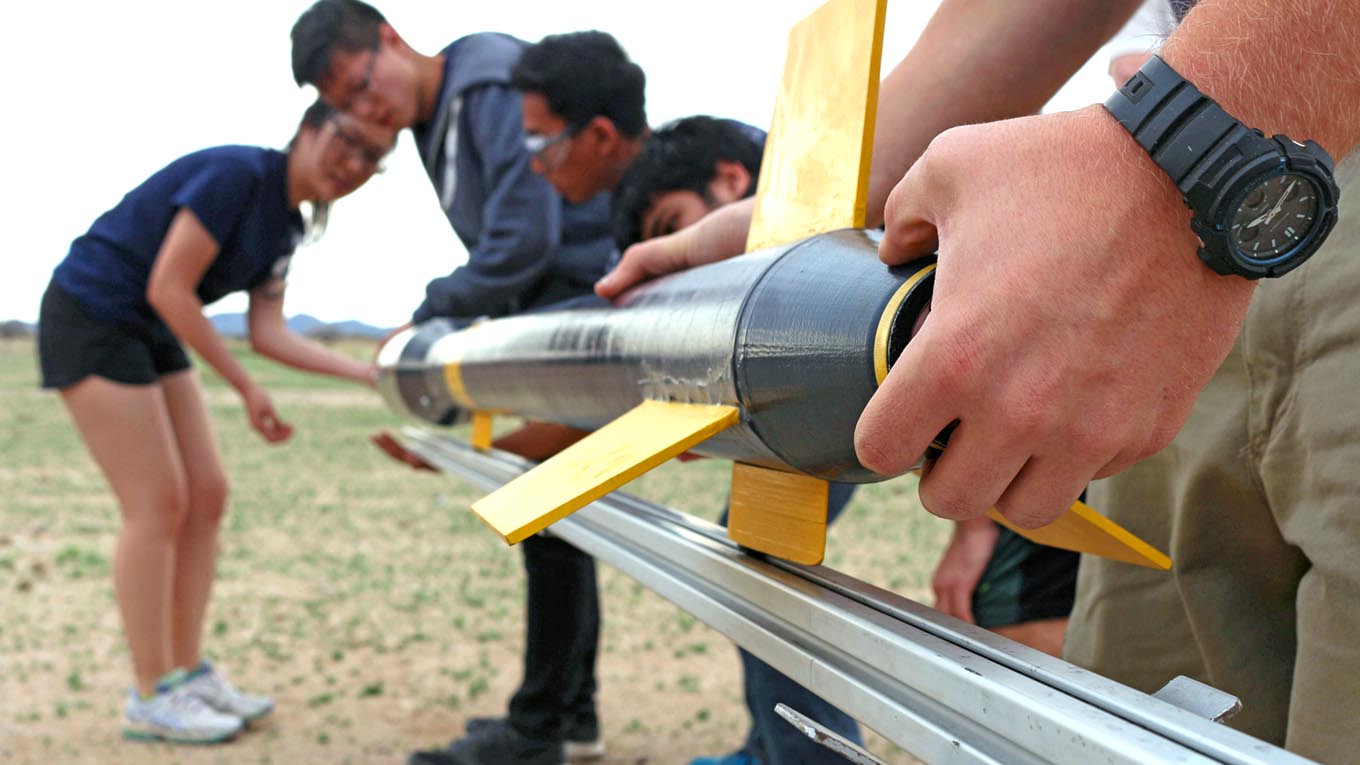
 UC Berkeley's Space Technologies and Rocketry (STAR) team prepares its Arktos rocket for launch. (Photo courtesy STAR/Berkeley Engineering)
Aerospace Engineering
In this section
Leonardo da Vinci wrote, “Once you have tasted flight, you will forever walk the earth with your eyes turned skyward. For there you have been, and there you will always long to return.” Perhaps, like da Vinci, you’ve always been obsessed with airborne machines: gliders and lighter-than-air craft. Fixed-wing airplanes and jets. Autogyros and helicopters. Or even rockets, satellites and spacecraft. Aeronautical engineers generally design aircraft to fly within the Earth’s atmosphere, while astronautical engineers design the technology for spacecraft to fly beyond the atmosphere. Either way, the sky’s the limit.
Why choose Berkeley?
Contact
Aerospace Engineering program
6131 Etcheverry Hall
(510) 642-3358
aero@berkeley.edu
We offer a modern aerospace engineering major that combines comprehensive topical coverage, technical rigor and practical relevance. This major has been designed from the ground up for students who aspire to become leaders in an emerging era of aerospace technologies, including sustainable aviation, autonomous flight and space exploration. With a UC Berkeley aerospace engineering degree, you can find employment in industry — such as multinational corporations that design and manufacture aerospace systems at scale, or mid-size and small private companies that develop targeted technologies — or in federal government agencies such as NASA, the FAA or federal defense organizations.
Interested? Learn more about the Aerospace Engineering program.


Degree worksheets
The easiest, most convenient way to track your progress toward your degree requirements is to use a degree worksheet, with guidelines specific to your year of admission. You should bring your worksheet with you whenever you meet with your Engineering Student Services or faculty adviser. From your ‘My Academics’ page on CalCentral, use the ‘Semesters’ section to help complete your worksheet. When available, you can also use the Academic Progress Report to help update your degree worksheet.
Current degree worksheet: 2026
Engineering Student Services
120 Grimes Engineering Center
Berkeley, CA 94720
ess@berkeley.edu
(510) 642-7594
Degree requirements
Undergraduate programs and degree worksheets from previous years are available through the Undergraduate Guide archive.
| Course | Fall | Spring |
|---|---|---|
| Freshman Year | ||
| AEROENG 1 – Aerospace Engineering 1 Seminar |
1
|
–
|
| AEROENG 2 – Aerospace Engineering 2 Seminar |
–
|
1
|
| ENGIN 7 – Introduction to Computer Programming and Numerical Methods, or COMPSCI 61A1 – The Structure and Interpretation of Computer Programs |
–
|
4
|
| MATSCI 45 – Properties of Materials |
3
|
–
|
| MATSCI 45L – Properties of Materials Laboratory |
1
|
–
|
| MATH 51 – Calculus I |
4
|
–
|
| MATH 52 – Calculus II |
–
|
4
|
| PHYSICS 7A – Physics for Scientists and Engineers, or PHYSICS 5A – Introductory Mechanics and Relativity2 |
–
|
4
|
| Science Elective3 |
3-5
|
–
|
| Reading & Composition Part A Course4 |
4
|
–
|
| Reading & Composition Part B Course4 |
–
|
4
|
| Total |
16-18
|
17
|
| Sophomore Year | ||
| AEROENG 10 – Aerospace Engineering: Introduction to Aerospace Design |
4
|
–
|
| MATH 53 – Multivariable Calculus |
4
|
–
|
| MATH 54 – Linear Algebra and Differential Equations (recommended), or PHYSICS 89 – Introduction to Mathematical Physics |
–
|
4
|
| MECENG 40 – Thermodynamics, or ENGIN 40 – Engineering Thermodynamics5 |
–
|
3-4
|
| MECENG C85 – Introduction to Solid Mechanics |
–
|
3
|
| PHYSICS 7B – Physics for Scientists and Engineers, or PHYSICS 5B – Introductory Electromagnetism, Waves, and Optics+5BL – Introduction to Experimental Physics I2 |
4 or 5
|
–
|
| Humanities/Social Sciences Courses4 |
3-4
|
3-4
|
| Total |
15-17
|
13-15
|
| Junior Year | ||
| Electronics: EECS 149 – Introduction to Embedded Systems5, ELENG 120 – Signals and Systems, or MECENG 100 – Electronics for the Internet of Things |
–
|
4
|
| Dynamics: CIVENG 126 – Engineering Dynamics and Vibrations, or MECENG 104 – Engineering Mechanics II |
3
|
–
|
| Statistics and Data Science: CIVENG 93 – Engineering Data Analysis, or DATA/COMPSCI/STAT C1006 – Principles & Techniques of Data Science, or ENGIN 178 – Statistics and Data Science for Engineers |
–
|
3-4
|
| Controls: MECENG 132 – Dynamic Systems and Feedback5 |
3
|
–
|
| MECENG 106 – Fluid Mechanics |
3
|
–
|
| Technical Elective7 |
–
|
3-4
|
| Humanities/Social Sciences Courses4 |
3-4
|
3-4
|
| Total |
12-13
|
13-16
|
| Senior Year | ||
| MECENG 103 – Experimentation and Measurements |
4
|
–
|
| MECENG 163 – Engineering Aerodynamics |
–
|
3
|
| AEROENG 100 – Aerospace Engineering Capstone Design |
–
|
4
|
| Technical Electives7 |
6-8
|
3-4
|
| Free Electives8 |
2-4
|
2-4
|
| Total |
12-15
|
12-15
|
Notes
*A minimum of 120 units is required for graduation.
1Students who choose to take COMPSCI 61A can take COMPSCI 61A in the fall and MATSCI 45 in the spring.
2Students may choose to take the Physics 7 series or the Physics 5 series. Students who fulfill PHYSICS 7A with an AP exam score, transfer work, or at Berkeley may complete the physics requirement by taking either PHYSICS 7B, or PHYSICS 5B and 5BL. Students who take PHYSICS 5A must take PHYSICS 5B and 5BL to complete the physics requirement. Completion of PHYSICS 5A and PHYSICS 7B will not fulfill the physics requirement.
3Choose one of the following: ASTRON 7A, C10; BIOLOGY 1A+1AL, 1B; CHEM 1A/1AL, 1B, 3A/3AL, 3B/3BL, 4A, 4B; MCELLBI 32; PHYSICS 7C. Some of these courses require prerequisites and would therefore be more appropriately taken in a later semester. Students who plan to take MECENG 40 for their Thermodynamics requirement in sophomore year will need to take CHEM 1A/1AL to fulfill their Science Elective, because CHEM 1A/1AL are prerequisites for MECENG 40.
4The Humanities/Social Sciences (H/SS) requirement includes two approved Reading & Composition (R&C) courses and four additional approved courses, with which a number of specific conditions must be satisfied. R&C courses must be taken for a letter grade (C- or better required). The first half (R&C Part A) must be completed by the end of the freshman year; the second half (R&C Part B) must be completed no later than the end of the sophomore year. The remaining courses may be taken at any time during the program. See engineering.berkeley.edu/hss for complete details and a list of approved courses.
5 MECENG 132, ENGIN 40 and EECS 149 are typically only offered in the fall semester.
6The enrollment system enforces prerequisites for DATA/COMPSCI/STAT C100; therefore, students who have not completed C8 will be unable to enroll in the course.
7Technical electives: Students must take four elective courses from two of the areas on this course list (two courses from each area).
8Free electives can be any technical or non-technical course, a course of your interest offered by any department at UC Berkeley; there are no restrictions. Free electives may be necessary in order to obtain the minimum 120 units required for graduation.
| Course | Fall | Spring |
|---|---|---|
| 1st and 2nd Semesters | ||
| AEROENG 1 – Aerospace Engineering 1 Seminar | 1 | – |
| AEROENG 2 – Aerospace Engineering 2 Seminar | – | 1 |
| ENGIN 7 – Introduction to Computer Programming and Numerical Methods, or COMPSCI 61A – The Structure and Interpretation of Computer Programs |
4
|
–
|
| MATSCI 45 – Properties of Materials |
3
|
–
|
| MATSCI 45L – Properties of Materials Laboratory |
1
|
–
|
| MECENG C85 – Introduction to Solid Mechanics |
3
|
–
|
| Dynamics: CIVENG 126 – Engineering Dynamics and Vibrations, or MECENG 104 – Engineering Mechanics II |
–
|
3
|
| Electronics: EECS 149 – Introduction to Embedded Systems1 , or ELENG 120 – Signals and Systems, or MECENG 100 – Electronics for the Internet of Things |
–
|
4
|
| MECENG 40 – Thermodynamics, or ENGIN 40– Engineering Thermodynamics1 |
–
|
3-4
|
| Humanities/Social Sciences Courses2 |
3-4
|
3-4
|
| Total |
15-16
|
14-16
|
| 3rd and 4th Semesters | ||
| AEROENG 10 – Aerospace Engineering: Introduction to Aerospace Design |
4
|
–
|
| MECENG 106 – Fluid Mechanics |
3
|
–
|
| MECENG 163 – Engineering Aerodynamics |
–
|
3
|
| Controls: ELENG C128/MECENG C134 – Feedback Control Systems, or MECENG 132 – Dynamic Systems and Feedback1 |
3-4
|
–
|
| Statistics and Data Science: CIVENG 93 – Engineering Data Analysis, or DATA/COMPSCI/STAT C100 – Principles & Techniques of Data Science3, or ENGIN 178 – Statistics and Data Science for Engineers |
–
|
3-4
|
| Technical Electives4 |
3-4
|
3-4
|
| Humanities/Social Sciences Courses2 |
3-4
|
3-4
|
| Total |
16-19
|
12-15
|
| 5th Semester** | ||
| MECENG 103 – Experimentation and Measurements |
4
|
– |
| AEROENG 100 – Aerospace Engineering Capstone Design |
4
|
– |
| Technical Elective4 |
6-8
|
– |
| Total |
14-16
|
|
Notes
*A minimum of 120 units is required for graduation.
**Transfer students who would like to enroll for a fifth semester must contact their ESS Adviser to change their degree term.
1MECENG 132, ENGIN 40 and EECS 149 are typically only offered in the fall semester.
2The Humanities/Social Science (H/SS) requirement includes two approved Reading & Composition courses and four additional approved courses, with which a number of specific conditions must be satisfied. Reading & Composition parts A and B must be completed by no later than the end of the sophomore year. The remaining courses may be taken at any time during the program. See engineering.berkeley.edu/hss for complete details and a list of approved courses.
3The enrollment system enforces prerequisites for DATA/COMPSCI/STAT C100; therefore, students who have not completed C8 will be unable to enroll in the course.
4Technical electives: Students must take four elective courses from two of the areas on this course list
(two courses from each area).
If you would like to receive these documents in an alternative, accessible format, please contact eng-ada@berkeley.edu.