• Skip to main content
  • Skip to primary navigation
  • Departments
    • Bioengineering
    • Civil and Environmental Engineering
    • Electrical Engineering and Computer Sciences
    • Industrial Engineering and Operations Research
    • Materials Science and Engineering
    • Mechanical Engineering
    • Nuclear Engineering
    • Aerospace program
    • Engineering Science program
  • News
    • Berkeley Engineer magazine
    • Social media
    • News videos
    • News digest (email)
    • Brand & Press kit
  • Events
    • Cal Day
    • Commencement
    • Events calendar
    • Homecoming
    • Kuh Lecture Series
    • Minner Lecture
    • Space reservations
    • View from the Top
  • College directory
  • For staff & faculty
Berkeley Engineering

Educating leaders. Creating knowledge. Serving society.

  • About
    • Facts & figures
    • Rankings
    • Mission & values
    • Equity & inclusion
    • Voices of Berkeley Engineering
    • Leadership team
    • Milestones
    • Buildings & facilities
    • Maps
  • Admissions
    • Undergraduate admissions
    • Graduate admissions
    • New students
    • Visit
    • Maps
    • Admissions events
    • K-12 outreach
  • Academics
    • Undergraduate programs
    • Majors & minors
    • Undergraduate Guide
    • Graduate programs
    • Graduate Guide
    • Innovation & entrepreneurship
    • Kresge Engineering Library
    • International programs
    • Executive education
  • Students
    • New students
    • Advising & counseling
    • ESS programs
    • CAEE academic support
    • Grad student services
    • Student life
    • Wellness & inclusion
    • Undergraduate Guide
    • > Degree requirements
    • > Policies & procedures
    • Forms & petitions
    • Resources
  • Research & faculty
    • Centers & institutes
    • Undergrad research
    • Faculty
    • Sustainability and resiliency
  • Connect
    • Alumni
    • Industry
    • Give
    • Stay in touch
  • Undergraduate programs
    • Aerospace Engineering
    • Bioengineering
    • Civil Engineering
    • Electrical Engineering & Computer Sciences
    • Engineering Science
    • Industrial Engineering & Operations Research
    • Materials Science & Engineering
    • Mechanical Engineering
    • Nuclear Engineering
    • Undeclared
  • Majors & minors
    • Major options
    • Minors
    • Change of major
  • Undergraduate Guide
  • Graduate programs
    • Professional master’s programs
    • MBA/MEng
  • Graduate Guide
  • Innovation & entrepreneurship
  • Kresge Engineering Library
  • International programs
    • GLOBE
    • Study abroad
  • Executive education
Home > Academics > Undergraduate programs > Nuclear Engineering
NSSC Executive Director Bethany Goldblum and NSSC Fellow Adriana Sweet writing on a glass board.Bethany Goldblum (right), executive director of the Nuclear Science and Security Consortium, working at Berkeley Lab with NSSC fellow Adriana Sweet. (Photo courtesy NSSC)

Nuclear Engineering

  • Overview
  • Degree requirement
  • Degree worksheet

You know that the world’s most pressing challenges find their solutions in the power of nuclear technology. And you want to help solve those problems, whether by innovating in industry, leading in government or pioneering research in academia or the national laboratories. From the climate crisis to global health and security, nuclear engineers lead research and development using nuclear energy and radiation to produce electricity, power spacecraft and advance life-saving medicines. This is a field of immense power — and it’s expanding rapidly.

Why choose Berkeley?

Contact

Department of Nuclear Engineering
4153 Etcheverry Hall # 1730
Berkeley, CA 94720-1730
(510) 642-4077
More information

Because our nuclear engineering department plays a leading role in advancing nuclear science and engineering for an array of applications. These include fission power generation and fusion energy on earth and in space, medical physics, nonproliferation and global security, and artificial intelligence for nuclear applications. Our undergraduate students perform research under the guidance of UC Berkeley faculty as well as in collaboration with scientists at nearby national laboratories. The department also has strong partnerships with the nuclear industry to facilitate internship placements. Our program is consistently ranked among the top in the nation, and our award-winning faculty bring the resources of a global powerhouse directly into the classroom.

Berkeley faculty are currently conducting research and designing next-generation tools for nuclear forensics and safeguards, characterizing materials in extreme environments to support advances in fusion energy systems, and developing new pathways for next-generation cancer therapy.

Sound interesting? Learn more about the Department of Nuclear Engineering.
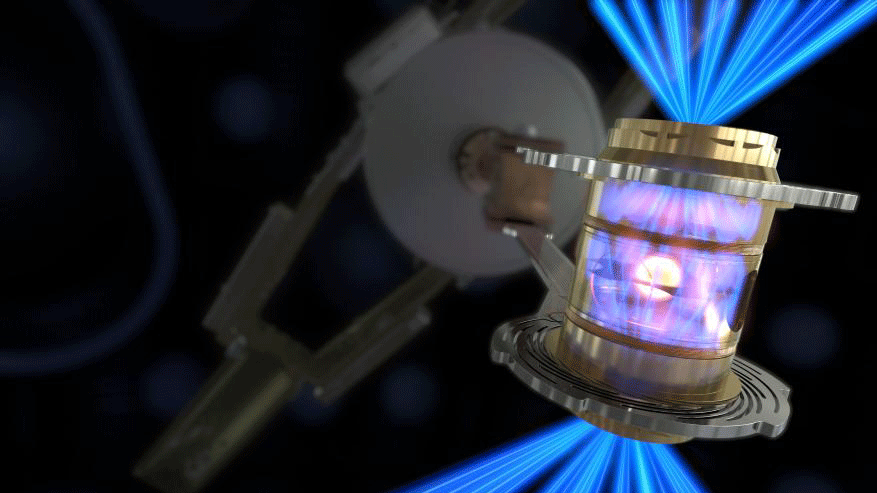
hohlraum converting laser energy into X-rays

Berkeley Engineering alumni help achieve decades-long quest for nuclear fusion

Molten salts being broken up in a mortar and pestle

Nuclear power renaissance

Engineering Student Services
120 Grimes Engineering Center
Berkeley, CA 94720
ess@berkeley.edu
(510) 642-7594

Department Contacts

Degree worksheet:  2026

Undergraduate programs and degree worksheets from previous years are available through the Undergraduate Guide archive.

Course Fall Spring
Freshman Year
CHEM 1A+1AL – General Chemistry, or CHEM 4A – General Chemistry and Quantitative Analysis1
5
–
ENGIN 7 – Introduction to Computer Programming and Numerical Methods
–
4
MATH 51 – Calculus I
4
–
MATH 52 – Calculus II
–
4
PHYSICS 7A – Physics for Scientists and Engineers
–
4
NUCENG 10 – What Do Nuclear Engineers Do?
1
–
Reading & Composition Part A Course2
4
–
Reading & Composition Part B Course2
–
4
Humanities/Social Sciences Course2
3-4
–
Total
17-18
16
Sophomore Year
MATSCI 45 – Properties of Materials + MATSCI 45L – Properties of Materials Laboratory
4
–
Electronic Circuits Elective3
–
3-4
MATH 53 – Multivariable Calculus
4
–
MATH 54 – Linear Algebra and Differential Equations
–
4
PHYSICS 7B – Physics for Scientists and Engineers
4
–
PHYSICS 7C – Physics for Scientists and Engineers
–
4
Humanities/Social Sciences Courses2
3-4
3-4
Total
15-16
14-16
Junior Year
ENGIN 40 – Engineering Thermodynamics
4
–
NUCENG 100 – Introduction to Nuclear Energy and Technology
3
–
NUCENG 101 – Nuclear Reactions and Radiation
4
–
NUCENG 104 – Radiation Detection and Nuclear Instrumentation Laboratory
–
4
NUCENG 150 – Nuclear Reactor Theory
–
4
Statistics/Data Analysis Elective4
3-8
–
Technical Elective5
–
4
Humanities/Social Sciences Course (with Ethics Content)2,6
–
3-4
Free elective7
–
1
Total
14-19
16-17
Senior Year
NUCENG 170A – Nuclear Design:  Design in Nuclear Power Technology and Instrumentation
–
3
Technical Electives5
13
12
Total
13
15
Notes

1CHEM 4A is for students intending a major in chemistry or chemical engineering.

2The Humanities/Social Sciences (H/SS) requirement includes two approved Reading & Composition (R&C) courses and four additional approved courses, with which a number of specific conditions must be satisfied. R&C courses must be taken for a letter grade (C- or better required). The first half (R&C Part A) must be completed by the end of the freshman year; the second half (R&C Part B) must be completed by no later than the end of the sophomore year. The remaining courses may be taken at any time during the program. See engineering.berkeley.edu/hss for complete details and a list of approved courses.

3Electronic Circuits Elective: Choose one course from ELENG 66, ENGIN 11, MECENG 100, or PHYSICS 111A.

4Statistics/Data Analysis Elective: Statistics/Data Analysis Elective: Choose one course from ENGIN 178 (recommended), DATA C8 + DATA C88S OR DATA 88 connector (must take both), DATA C100, DATA C140, EECS 126, INDENG 172, STAT 133, or STAT 134.

5Students must complete 29 technical elective units which must include at least 17 units of upper division nuclear engineering courses. The remaining 12 technical elective units must be fulfilled by taking courses in engineering and science, of which a minimum of 9 units must be upper division and be in one of the following departments: astronomy, chemistry, data, earth and planetary science, integrative biology, mathematics, molecular cell biology, physics, plant & microbial biology, statistics or any engineering department (including NUCENG). Students must consult with and obtain approval from their faculty adviser no later than the fall semester of their junior year for their choices of technical elective courses.

Students have the option of using 3 units from the following lower division courses:  ASTRON 7A, 7B; BIOENG 10; BIOLOGY 1A, 1AL, 1B; CHEM 1B, 3A, 3B, 4B; CIVENG 11, 60, 70, 93; CIVENG C30, W30; COMPSCI C8, 61A, W61A, 61B, W61B, 61BL, 61C, 61CL, 70; DESINV 15, 22, 90E; ELENG 64; ENGIN 26, 29, 68; EPS 50; INTEGBI 32, MATH 55; MCELLBI 32; MECENG C85, W85; PHYSICS 89, W89; STAT 20, 21.  Any course cross-listed with this list can also be used for this requirement.

Technical electives cannot include any course taken on a P/NP basis; any course that counts as H/SS; courses numbered 24, 39, 84, 88; BIOENG 100, 153; CHEM 100, 149, 192; COMPSCI 194-100; DATA C104, 145; DESINV courses (except DESINV 15, 22, 23, 90E, 190E); ENGIN 125, 157AC, 170 series, 180, 183 series, 184, 185, 187, 188, 195 series; EPS C100; INDENG 95, 171 (if taken Sp23 or later), 185, 186, 190 series, 191, 192, 195; INTEGBI 35AC, 88, 101, C105, 191; MATH C103, 151, 152, 153, 160; MCELLBI 186B; MECENG 126, 191K; PHYSICS 100. Students may receive up to three units of technical elective credit for graded research in H194 or 196.  NWMEDIA 136 can be taken.

Upper division technical electives

The following groups of electives should help undergraduate students focus their choices on specific professional goals. The electives selected need not be from any single group.

Beam and Accelerator Applications: NUCENG 155, 180; PHYSICS 110A, 110B (ELENG 117 may be substituted for PHYSICS 110A and 110B), 129, 139, 142

Bionuclear Engineering: BIOENG C165; ELENG 120, C145B; NUCENG 107, 162

Computational Methods: COMPSCI 169; MATH 104, 110, 128A; NUCENG 155; STAT 134, 150

Fission Power Engineering: MECENG 106, 109 (CHMENG 150A may be substituted for MECENG 106 and 109); NUCENG 120, 124, 155, 161, 167, 175

Fusion Power Engineering: NUCENG 120, 155, 180; PHYSICS 110A, 110B, 142

Homeland Security and Nonproliferation: CHEM 143; NUCENG 102, 107, 130, 155, 175; PHYSICS 110A, 110B, 111A, 111B

Materials in Nuclear Technology: MATSCI 102, 104, 112, 113; NUCENG 120, 124, 155, 161

Nuclear Fuel Cycles and Waste Management: CHMENG 150A, 150B; ENGIN 120 or INDENG 120; MATSCI 112; NUCENG 120, 124, 155, 161, 175

Radiation and Health Physics:  NUCENG 102, 120, 155, 162, 180

Risk, Safety and Systems Analysis: CIVENG 193; CHMENG 150A; ENGIN 120 or INDENG 120; INDENG 166; NUCENG 120, 124, 155, 161, 167, 175

6Students must take one course with ethics content. This may be fulfilled within the Humanities/Social Sciences requirement by taking one of the following courses: ANTHRO 156B; BIOENG 100; ENGIN 125, 157AC, 185; ESPM 161, 162; GEOG 31; IAS 157AC; ISF 100E; L&S 160B; PHILOS 2, 104, 107; SOCIOL 116.

7Free electives can be any technical or non-technical course, any course of your interest offered by any department; there are no restrictions. Free electives may be necessary in order to obtain the minimum 120 units for graduation.

* A minimum of 120 units is required for graduation.

 
Course Fall Spring
1st and 2nd Semesters
ENGIN 7 – Introduction to Computer Programming and Numerical Methods
4
–
MATSCI 45 – Properties of Materials + MATSCI 45L – Properties of Materials Laboratory
4
–
NUCENG 100 – Introduction to Nuclear Energy and Technology 3 –
NUCENG 101 – Nuclear Reactions and Radiation
4
Statistics/Data Analysis Elective1
–
3-8
NUCENG 104 – Radiation Detection and Nuclear Instrumentation Laboratory – 4
NUCENG 150 – Introduction to Nuclear Reactor Theory – 4
NUCENG 10 – What Do Nuclear Engineers Do?
1
Humanities/Social Sciences Course2,3
–
3-4
Total
16
14-20
3rd and 4th Semesters
ENGIN 40 – Engineering Thermodynamics
4
–
NUCENG 170A – Nuclear Design:  Design in Nuclear Power Technology and Instrumentation – 3
Electronic Circuits Elective4 3-4
Technical Electives5
3
10
Humanities/Social Sciences Courses2,3
3-4
3-4
Total
13-15
16-17
5th Semester**
Technical Electives5
10
Humanities/Social Sciences Course2,3
3-4
Total
13-14
Notes

* A minimum of 120 units is required for graduation.

**Transfer students who would like to enroll for a fifth semester must contact their ESS Adviser to change their degree term.

1Statistics/Data Analysis Elective: Statistics/Data Analysis Elective: Choose one course from ENGIN 178 (recommended), DATA C8 + DATA C88S OR DATA 88 connector (must take both), DATA C100, DATA C140, EECS 126, INDENG 172, STAT 133, or STAT 134.

2The Humanities/Social Science (H/SS) requirement includes two approved Reading & Composition courses and four additional approved courses, with which a number of specific conditions must be satisfied. Reading & Composition parts A and B must be completed by no later than the end of the sophomore year. The remaining courses may be taken at any time during the program. See engineering.berkeley.edu/hss for complete details and a list of approved courses.

3Students must take one course with ethics content. This may be fulfilled within the Humanities/Social Sciences requirement by taking one of the following courses: ANTHRO 156B; BIOENG 100; ENGIN 125, 157AC, 185; ESPM 161, 162; GEOG 31; IAS 157AC; ISF 100E; L&S 160B; PHILOS 2, 104, 107; SOCIOL 116.

4Electronic Circuits Elective: Choose one course from ELENG 66, ENGIN 11, MECENG 100, or PHYSICS 111A.

5Transfer students must complete 26 technical elective units which must include at least 14 units of upper division nuclear engineering courses. The remaining 12 technical elective units must be fulfilled by taking courses in engineering and science, of which a minimum of 9 units must be upper division and be in one of the following departments: astronomy, chemistry, data, earth and planetary science, integrative biology, mathematics, molecular cell biology, physics, plant & microbial biology, statistics or any engineering department (including NUCENG). Students must consult with and obtain approval from their faculty adviser no later than the fall semester of their junior year for their choices of technical elective courses.

Students have the option of using 3 units from the following lower division courses:  ASTRON 7A, 7B; BIOENG 10; BIOLOGY 1A, 1AL, 1B; CHEM 1B, 3A, 3B, 4B; CIVENG 11, 60, 70, 93; CIVENG C30, W30; COMPSCI C8, 61A, W61A, 61B, W61B, 61BL, 61C, 61CL, 70; DESINV 15, 22, 90E; ELENG 64; ENGIN 26, 29; EPS 50; INTEGBI 32, MATH 55; MCELLBI 32; MECENG C85, W85; PHYSICS 89, W89; STAT 20, 21.  Any course cross-listed with this list can also be used for this requirement.

Technical electives cannot include any course taken on a P/NP basis; any course that counts as H/SS; courses numbered 24, 39, 84, 88; BIOENG 100, 153; CHEM 100, 149, 192; COMPSCI 194-100; DATA C104, 145; DESINV courses (except DESINV 15, 22, 23, 90E, 190E); ENGIN 125, 157AC, 170 series, 180, 183 series, 184, 185, 187, 188, 195 series; EPS C100; INDENG 95, 171 (if taken Sp23 or later), 185, 186, 190 series, 191, 192, 195; INTEGBI 35AC, 88, 101, C105, 191; MATH C103, 151, 152, 153, 160; MCELLBI 186B; MECENG 126, 191K; PHYSICS 100. Students may receive up to three units of technical elective credit for graded research in H194 or 196.  NWMEDIA 136 can be taken.

Upper division technical electives

The following groups of electives should help undergraduate students focus their choices on specific professional goals. The electives selected need not be from any single group.

Beam and Accelerator Applications: NUCENG 155, 180; PHYSICS 110A, 110B (ELENG 117 may be substituted for PHYSICS 110A and 110B), 129, 139, 142

Bionuclear Engineering: BIOENG C165; ELENG 120, C145B; NUCENG 107, 162

Computational Methods: COMPSCI 169; MATH 104, 110, 128A; NUCENG 155; STAT 134, 150

Fission Power Engineering: MECENG 106, 109 (CHMENG 150A may be substituted for MECENG 106 and 109); NUCENG 120, 124, 155, 161, 167, 175

Fusion Power Engineering: NUCENG 120, 155, 180; PHYSICS 110A, 110B, 142

Homeland Security and Nonproliferation: CHEM 143; NUCENG 102, 107, 130, 155, 175; PHYSICS 110A, 110B, 111A, 111B

Materials in Nuclear Technology: MATSCI 102, 104, 112, 113; NUCENG 120, 124, 155, 161

Nuclear Fuel Cycles and Waste Management: CHMENG 150A, 150B; ENGIN 120 or INDENG 120; MATSCI 112; NUCENG 120, 124, 155, 161, 175

Radiation and Health Physics:  NUCENG 102, 120, 155, 162, 180

Risk, Safety and Systems Analysis: CIVENG 193; CHMENG 150A; ENGIN 120 or INDENG 120; INDENG 166; NUCENG 120, 124, 155, 161, 167, 175

The easiest, most convenient way to track your progress toward your degree requirements is to use a degree worksheet, with guidelines specific to your year of admission. You should bring your worksheet with you whenever you meet with your Engineering Student Services or faculty adviser. From your ‘My Academics’ page on CalCentral, use the ‘Semesters’ section to help complete your worksheet. When available, you can also use the Academic Progress Report to help update your degree worksheet.

Nuclear Engineering:  2019 | 2020 | 2021 | 2022 | 2023 | 2024 | 2025 | 2026

If you would like to receive these documents in an alternative, accessible format, please contact eng-ada@berkeley.edu.

  • Contact
  • Give
  • Privacy
  • UC Berkeley
  • Accessibility
  • Nondiscrimination
  • instagram
  • X logo
  • linkedin
  • facebook
  • youtube
  • bluesky
© 2026 UC Regents