• Skip to main content
  • Skip to primary navigation
  • Departments
    • Bioengineering
    • Civil and Environmental Engineering
    • Electrical Engineering and Computer Sciences
    • Industrial Engineering and Operations Research
    • Materials Science and Engineering
    • Mechanical Engineering
    • Nuclear Engineering
    • Aerospace program
    • Engineering Science program
  • News
    • Berkeley Engineer magazine
    • Social media
    • News videos
    • News digest (email)
    • Press kit
  • Events
    • Events calendar
    • Commencement
    • Homecoming
    • Cal Day
    • Space reservations
    • View from the Top
    • Kuh Lecture Series
    • Minner Lecture
  • College directory
  • For staff & faculty
Berkeley Engineering

Berkeley Engineering

Educating leaders. Creating knowledge. Serving society.

  • About
    • Facts & figures
    • Rankings
    • Mission & values
    • Equity & inclusion
    • Voices of Berkeley Engineering
    • Leadership team
    • Milestones
    • Buildings & facilities
    • Maps
  • Admissions
    • Undergraduate admissions
    • Graduate admissions
    • New students
    • Visit
    • Maps
    • Admissions events
    • K-12 outreach
  • Academics
    • Undergraduate programs
    • Majors & minors
    • Undergraduate Guide
    • Graduate programs
    • Graduate Guide
    • Innovation & entrepreneurship
    • Kresge Engineering Library
    • International programs
    • Executive education
  • Students
    • New students
    • Advising & counseling
    • ESS programs
    • CAEE academic support
    • Grad student services
    • Student life
    • Wellness & inclusion
    • Undergraduate Guide
    • > Degree requirements
    • > Policies & procedures
    • Forms & petitions
    • Resources
  • Research & faculty
    • Centers & institutes
    • Undergrad research
    • Faculty
    • Sustainability and resiliency
  • Connect
    • Alumni
    • Industry
    • Give
    • Stay in touch
Home > News

Research

New tenants at Richmond Field Station

05/01/12 — In January 2012, the Berkeley Lab named the Richmond Field Station as its top choice for a second campus; pending regulatory reviews, LBNL aims to open new research space by 2016.

Told in tears

05/01/12 — Bioengineering professor Amy Herr and graduate student Kelly Karns developed a microfluidic assay to test human tears for eye disease-specific proteins.

Slow going

05/01/12 — In California, single drivers of hybrid vehicles could drive in carpool lanes until 2011, but after the state put the brakes on the program, transportation engineer Michael Cassidy and graduate student Kitae Jang found that hybrids in standard lanes slowed traffic on Bay Area freeways.

Molecular Legos

05/01/12 — Led by bioengineering professor Seung-Wuk Lee, researchers have found a way to more easily work with collagen.
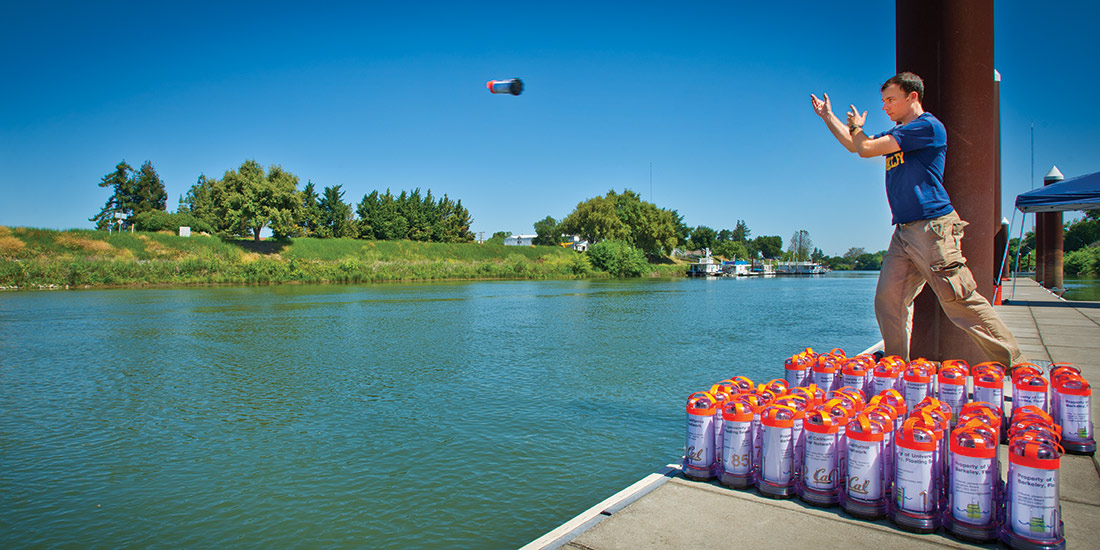
Launching water monitoring sensor into the Sacramento River

Putting water online

05/01/12 — In spring 2012, the Floating Sensor Network project, led by associate professor of EECS Alexandre Bayen, launched a flotilla of 100 robots down the Sacramento River to provide data on water movement and pollutant spread.
Berkeley Wireless Research Center researchers examine a printed circuit

From smart dust to smart rooms

05/01/12 — Small and inexpensive wireless sensors placed throughout our physical world are capturing and transmitting streams of information about conditions in places, things and even our behavior.
Grad students Kevin Peterson and EECS professor Ron Fearing with DASH+Wings

Winging it

05/01/12 — A small, roach-like robot with plastic wings borrowed from a toy is providing important insights into the natural history of flight.

Building green performance motorcycles

04/17/12 — Electric motorcycles are quiet, and from a power perspective more efficient. Both traits are not lost on the rider. “If you get on these electric motorcycles the first thing you notice is a magic carpet ride feel,” says Abe Askenazi, B.S'92, M.S'94 ME. “It's almost like flying. It feels like you are on a glider and this thing is propelling you forward. You don't hear all of the drama of power production, you are just doing it.” Askenazi has traveled a long road to become the chief technology officer at Zero Motorcycles, one of the nation's leading electric motorcycle manufacturers.

Berkeley and Stanford launch networking research center

04/10/12 Stanford University — Berkeley Engineering professor Scott Shenker is co-director of the new Open Networking Research Center, which is exploring software-defined networking (SDN) as a paradigm for making networks simpler and less expensive while expanding their capacities. Industry sponsors include Cisco, Google, Hewlett-Packard and Intel.

Smart sensors in the woods

03/19/12 — About 60 percent of the water used in California comes from Sierra Nevada snowmelt. Monthly measurements help water managers estimate the amount of water held in the snowpack and allow them to allocate the state's most precious resource. Now, the Sierra Nevada is going high tech. Wireless sensors developed by Steven Glaser, professor of civil and environmental engineering, are being tested in an ambitious pilot project at the UC Merced Sierra Nevada Research Institute.

Replacing the Osterizer as standard lab equipment

03/19/12 — After a year in Asia and South America visiting research labs that lacked the basics, Lina Nilsson - a post-doctoral researcher in the bioengineering lab of professor Daniel Fletcher - and a team of engineering colleagues brainstormed about how to develop low-cost, accessible tools that could produce research-grade results. The team evolved into Tekla Labs, a cooperative of ten partners from Berkeley Engineering and UCSF. Their idea won first place for social entrepreneurship in the 2010-11 Big Ideas @ Berkeley contest.

Maker of resonators

03/19/12 — Most days (and nights), you'll find Ernest Ting-Ta Yen, a mechanical engineering Ph.D. student, immersed in the complexities of his microelectromechanical systems research. The aluminum nitride resonators he builds, aimed at new cell phones and communications applications, are designed to help shrink mobile devices while increasing functionality. Happen upon him in his graduate student office at midnight, though, and you'll hear lovely strains of music. Yen practices from midnight to 2 a.m., the only hours available to this busy researcher.

Girls meet ‘the science of better’

02/09/12 — Industrial engineering professor Rhonda Righter (M.S'82, Ph.D'86 IEOR) is tackling a new assignment: serving as a volunteer role model to 35 middle-school girls. Visiting an after-school science enrichment program called Techbridge, Righter described her field and how she chose it to a group of students at Oakland's American Indian Public Charter School. Her presentation was intended to introduce the girls to engineering with the hope that they will one day be inspired to pursue studies and careers in it or a related field. “Industrial engineering is all about making things better,” Righter explained. “We're like detectives who solve puzzles.”

Self-assembling nanorods: Berkeley researchers obtain 1, 2 and 3D nanorod arrays and networks

02/01/12 Berkeley Lab — A relatively fast, easy and inexpensive technique for inducing nanorods to self-assemble into one-, two- and even three-dimensional macroscopic structures has been developed by a team of Lawrence Berkeley National Laboratory researchers. Leading this project was Ting Xu, a polymer scientist who holds joint appointments with Berkeley Lab's Materials Sciences Division and UC Berkeley's Departments of Materials Science and Engineering, and Chemistry.

Computers implanted in brain could help paralyzed

12/27/11 San Francisco Chronicle — It sounds like science fiction, but scientists around the world are getting tantalizingly close to building the mind-controlled prosthetic arms, computer cursors and mechanical wheelchairs of the future. Jose Carmena, a neuro-engineer at UC Berkeley and co-director of the Center for Neural Engineering and Prostheses at Berkeley and UCSF, puts his thoughts succinctly: "There's going to be an explosion in neural prosthetics."

Not your grandmother’s microscope

11/08/11 California Academy of Sciences — CellScope, a project initiated by UC Berkeley bioengineering professor Dan Fletcher and his students, has opened up the microscopic world to more people. The lightweight, mobile microscopes are not only being used in developing countries to diagnose disease, but also in classrooms to get kids excited about science.

Berkeley Lab research sparks record-breaking solar cell performances

11/07/11 Berkeley Lab — Theoretical research by scientists at LBNL has led to record-breaking sunlight-to-electricity conversion efficiencies in solar cells. The researchers showed that, contrary to conventional scientific wisdom, the key to boosting solar cell efficiency is not absorbing more photons but emitting more photons. "A great solar cell also needs to be a great Light Emitting Diode," says Eli Yablonovitch, the UC Berkeley professor of electrical engineering who led this research.

Manufacturing: The road to economic recovery

10/17/11 — We have become a nation of traders, regulators and middle parties. But are we still a nation of designers and makers? In the 1950s, manufacturing contributed more than 25 percent of the U.S. gross domestic product. Today, that share has fallen to below 12 percent. China is rapidly overtaking the United States as the world's largest manufacturing nation.

The brittleness of aging bones – more than a loss of bone mass

08/29/11 Berkeley Lab — New research at Berkeley shows that at microscopic dimensions, the age-related loss of bone quality can be every bit as important as the loss of quantity in the susceptibility of bone to fracturing. Using a combination of x-ray and electron based analytical techniques as well as macroscopic fracture testing, the researchers showed that the advancement of age ushers in a degradation of the mechanical properties of human cortical bone over a range of different size scales. "In characterizing age-related structural changes in human cortical bone at the micrometer and sub micrometer scales, we found that these changes degrade both the intrinsic and extrinsic toughness of bone," says Berkeley Engineering materials scientist Robert Ritchie.

Building the bio toolkit

05/04/11 — In the 1970s, the Berkeley-bred SPICE (Simulation Program with Integrated Circuit Emphasis) revolutionized microelectronics by creating a toolkit now used worldwide as the standard for circuit design. Our new Synthetic Biology Institute (SBI), launched on April 25, aims to repeat this feat with biological and chemical engineering.
  • « Go to Previous Page
  • Go to page 1
  • Interim pages omitted …
  • Go to page 30
  • Go to page 31
  • Go to page 32
  • Go to page 33
  • Go to page 34
  • Go to Next Page »
  • Contact
  • Give
  • Privacy
  • UC Berkeley
  • Accessibility
  • Nondiscrimination
  • instagram
  • X logo
  • linkedin
  • facebook
  • youtube
  • bluesky
© 2025 UC Regents