• Skip to main content
  • Skip to primary navigation
  • Departments
    • Bioengineering
    • Civil and Environmental Engineering
    • Electrical Engineering and Computer Sciences
    • Industrial Engineering and Operations Research
    • Materials Science and Engineering
    • Mechanical Engineering
    • Nuclear Engineering
    • Aerospace program
    • Engineering Science program
  • News
    • Berkeley Engineer magazine
    • Social media
    • News videos
    • News digest (email)
    • Press kit
  • Events
    • Cal Day
    • Commencement
    • Events calendar
    • Engineering Ethics workshop
    • Homecoming
    • Kuh Lecture Series
    • Minner Lecture
    • Space reservations
    • View from the Top
  • College directory
  • For staff & faculty
Berkeley Engineering

Berkeley Engineering

Educating leaders. Creating knowledge. Serving society.
  • About
    • Facts & figures
    • Rankings
    • Mission & values
    • Equity & inclusion
    • Voices of Berkeley Engineering
    • Leadership team
    • Milestones
    • Buildings & facilities
    • Maps
  • Admissions
    • Undergraduate admissions
    • Graduate admissions
    • New students
    • Visit
    • Maps
    • Admissions events
    • K-12 outreach
  • Academics
    • Undergraduate programs
    • Majors & minors
    • Undergraduate Guide
    • Graduate programs
    • Graduate Guide
    • Innovation & entrepreneurship
    • Kresge Engineering Library
    • International programs
    • Executive education
  • Students
    • New students
    • Advising & counseling
    • ESS programs
    • CAEE academic support
    • Grad student services
    • Student life
    • Wellness & inclusion
    • Undergraduate Guide
    • > Degree requirements
    • > Policies & procedures
    • Forms & petitions
    • Resources
  • Research & faculty
    • Centers & institutes
    • Undergrad research
    • Faculty
    • Sustainability and resiliency
  • Connect
    • Alumni
    • Industry
    • Give
    • Stay in touch
Home > News

Research

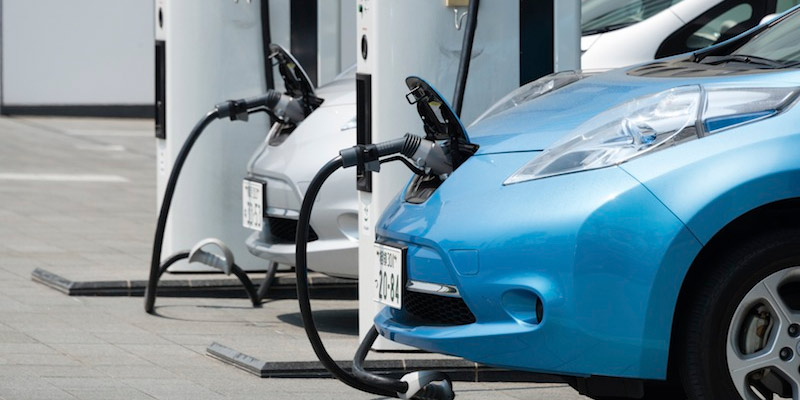
Charging electric cars

Electric vehicle batteries last longer than previously thought

03/30/15 Berkeley Lab — Scott Moura, assistant professor of civil and environmental engineering, has co-authored a study with Berkeley Lab colleagues that may alleviate concerns over battery life in electric vehicles.
Ivy clinging to wall

Synthetic coatings: Super surfaces

03/26/15 Nature — Characteristics adapted from lizards, ivy and other natural materials could help to engineer everyday objects with remarkable properties. Professor Phillip Messersmith, a Berkeley materials scientist and bioengineer, is studying mussel adhesive, which is ideal for securing objects underwater.
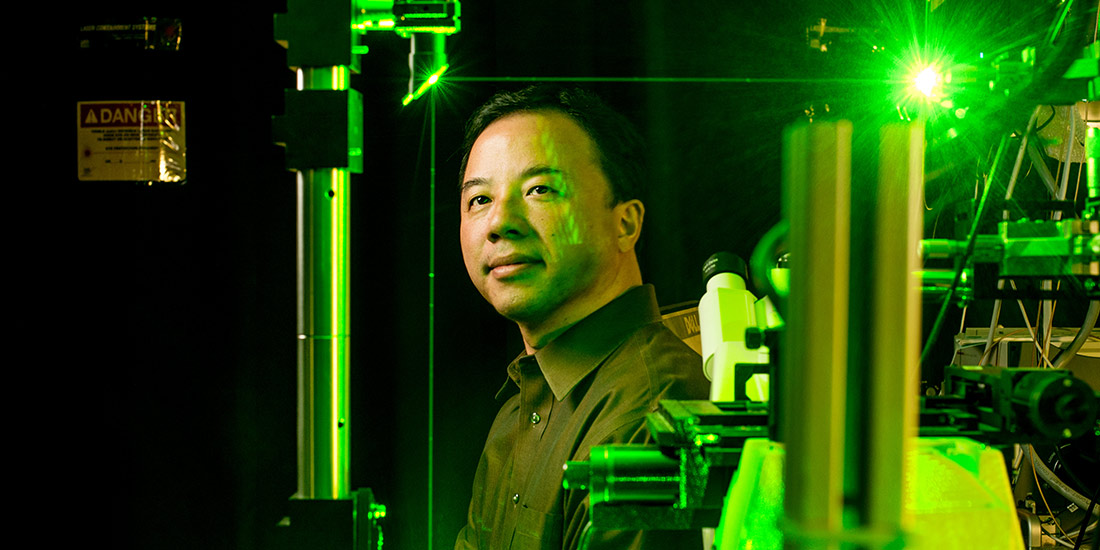
Xiang Zhang

The waves of the future may bend around metamaterials

03/24/15 New York Times — In recent years, scientists have learned how to construct materials that bend light, radar, radio, even seismic waves in ways that do not naturally occur. A key pioneer of these metamaterials is Berkeley Engineering's Xiang Zhang, whose lab has created optical “superlenses” that may one day surpass the power of today's microscopes.
Tensegrity robot

Tensegrity robots make headlines

03/23/15 BEST Lab — Tensegrity robots have been featured in a host of recent media articles. The spherical cable-and-rod structures are being developed by mechanical engineering professor Alice Agogino's team, working with NASA Ames and their collaborators, for tasks ranging from space exploration to home health care.
X-ray telescope image of the Bullet Cluster, providing evidence for dark matter

Heising-Simons Foundation supports Berkeley search for dark matter axions

03/18/15 — Dark-matter axion research at four U.S. institutions, led by nuclear engineering professor Karl van Bibber, is one of two new grants to UC Berkeley scientists from the Heising-Simons Foundation.
gloved hand holding

‘Smart bandage’ detects bedsores before they are visible to doctors

03/18/15 — Berkeley engineers have created a “smart bandage” that uses electrical currents to detect tissue damage from pressure ulcers, or bedsores, before they can be seen - while recovery is still possible.

A lightness of being

03/16/15 The Economist — An article on locomotion in microgravity mentions Berkeley mechanical engineering professor Alice Agogino's NASA-funded research on a “structurally compliant” rover designed to move across asteroids with a “punctuated rolling motion.”
Flying remote-controlled beetle

Cyborg beetle research allows free-flight study of insects

03/16/15 — Remote-controlled beetles equipped with radio backpacks are showcasing the potential of miniature electronics in biological research led by Berkeley engineers and Singapore's Nanyang Technological University.
chameleon-like skin

New chameleon-like material

03/12/15 — Berkeley engineers led by EECS professor Connie Chang-Hasnain have created an ultra-thin film that can shift colors as easily as a chameleon's skin when pulled or twisted.
Heart on a chip device

Bioengineers put human hearts on a chip

03/09/15 — Researchers have created a “heart-on-a-chip” technology that effectively uses human cardiac muscle cells derived from adult stem cells to model how a human heart reacts to cardiovascular medications. The system could one day replace animal models to screen for the safety and efficacy of new drugs.
Laura Waller

Bringing the invisible to light

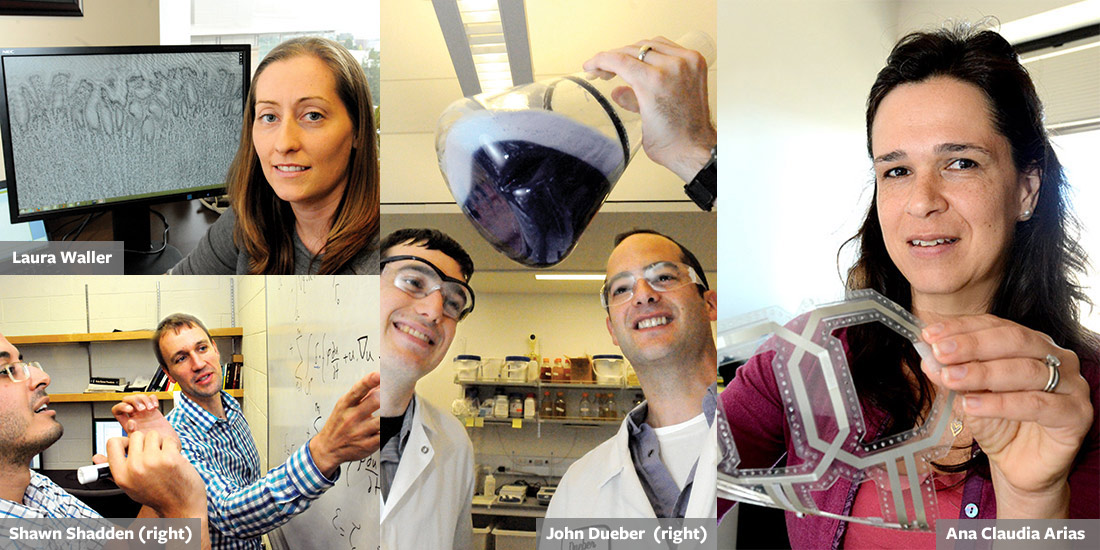
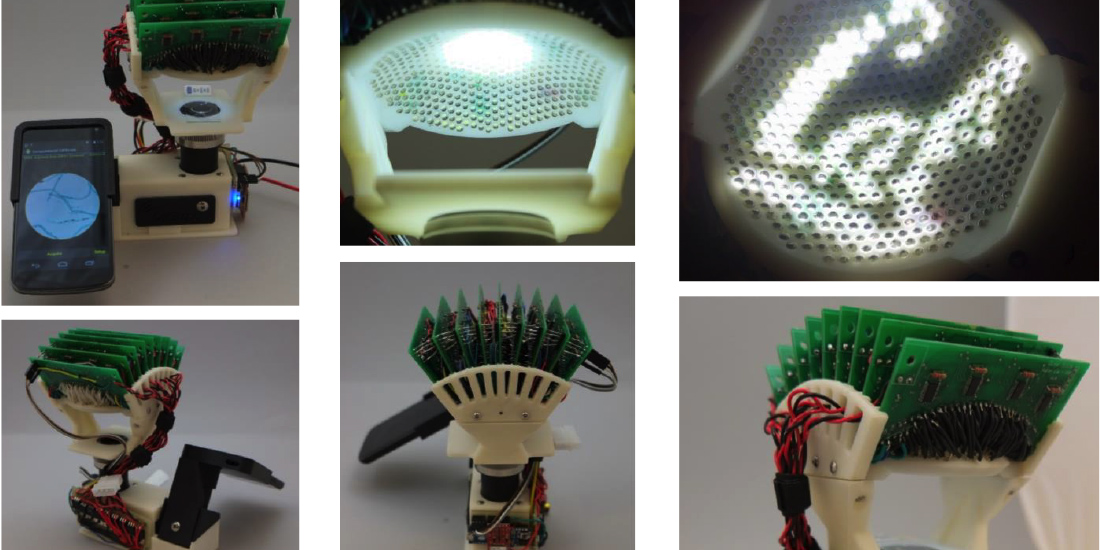
02/27/15 Berkeley Research — EECS professor Laura Waller is working on computational imaging methods for quantitative phase microscopy, which can be applied in a variety of scientific and industrial settings. Her work is supported by the Bakar Fellows Program for young faculty whose work holds commercial promise.
John Dueber (right) and bioengineering graduate student Zach Russ examine a culture of indigo-producing E. coli bacteria.

Greener blue jeans

02/23/15 Berkeley Research — The indigo that dyes your favorite pair of jeans blue is wildly popular, but very "dirty" to synthesize chemically. Bioengineering professor and Bakar fellow John Dueber thinks he has found an environmentally green way for industry to churn out the dye without toxic compounds.
Ana Claudia Arias with a printed electronic circuit

Wearable circuits could extend MRI’s reach

02/13/15 Berkeley Research — EECS associate professor Ana Claudia Arias is creating new wearable electronics based on printed circuits, to allow easier and better MRI imaging of sick infants, among others.
High-speed video of spot fire ignition

Engineering the spark that starts the wildfire

02/11/15 National Science Foundation — Hot metal fragments cast off by power lines, overheated brakes or other common sources can ignite a blaze if they land on the right fuel source. Now Berkeley mechanical engineers, supported by the NSF, are learning what ingredients and conditions cause this type of spot fire ignition.
LEDs (Wikipedia image)

Optical antenna enables LEDs to rival lasers

02/04/15 Berkeley Lab — A Berkeley Lab team, led by EECS professor Eli Yablonovitch, has used an external optical antenna to greatly enhance the spontaneous emission of light from a semiconductor nanorod. This advance opens the door to LEDs that can replace lasers for short-range optical communications.
Stripes showing differences in electron density in graphene

Graphene advances as viable silicon substitute

01/27/15 — A new study demonstrating a way to control the movement and placement of electrons in graphene moves the wonder material a major step closer to knocking silicon off as the dominant workhorse of the electronics industry. Among the study's lead authors is Berkeley Engineering's Lane Martin, associate professor of materials science and engineering.
Water treatment station in South Asia

Beyond clean water: A development engineer profile

01/13/15 Blum Center — Listening to a dry academic lecture on flood prediction while monsoons flooded a fifth of Pakistan sparked a humanitarian drive in Syed Imran Ali, now a Blum Center postdoc pursuing his vision of safe water delivery through development engineering.
atomic structure of a ferroelectric material

Discovery advances ferroelectrics in quest for lower power transistors

12/17/14 CITRIS — Berkeley engineers describe the first direct observation of a long-hypothesized but elusive phenomenon called “negative capacitance” in ferroelectric material, which could open the door to a radical reduction in the power consumed by transistors and the devices containing them.
Heavy truck entering the Caldecott Tunnel

Air pollution down thanks to California’s regulation of diesel trucks

12/12/14 Berkeley Lab — Detailed measurement of emissions from thousands of heavy trucks in the Bay Area by Berkeley Lab air quality scientists, led by adjunct professor Thomas Kirchstetter and professor Rob Harley, both of civil and environmental engineering, showed a dramatic reduction in pollutants in the wake of aggressive new regulations implemented by the California Air Resources Board.
Maneesh Agrawala

Paul Allen gives $5.7M to ‘cutting-edge’ artificial intelligence researchers

12/12/14 GeekWire — EECS professor Maneesh Agrawala, who is researching ways for machines to better "read" diagrams and other visualizations, is one of seven scientists who will share $5.7 million awarded this month by the Paul G. Allen Family Foundation as part of the Allen Distinguished Investigator Program.
  • « Go to Previous Page
  • Go to page 1
  • Interim pages omitted …
  • Go to page 24
  • Go to page 25
  • Go to page 26
  • Go to page 27
  • Go to page 28
  • Interim pages omitted …
  • Go to page 34
  • Go to Next Page »
  • Contact
  • Give
  • Privacy
  • UC Berkeley
  • Accessibility
  • Nondiscrimination
  • instagram
  • X logo
  • linkedin
  • facebook
  • youtube
  • bluesky
© 2026 UC Regents