• Skip to main content
  • Skip to primary navigation
  • Departments
    • Bioengineering
    • Civil and Environmental Engineering
    • Electrical Engineering and Computer Sciences
    • Industrial Engineering and Operations Research
    • Materials Science and Engineering
    • Mechanical Engineering
    • Nuclear Engineering
    • Aerospace program
    • Engineering Science program
  • News
    • Berkeley Engineer magazine
    • Social media
    • News videos
    • News digest (email)
    • Press kit
  • Events
    • Events calendar
    • Commencement
    • Homecoming
    • Cal Day
    • Space reservations
    • View from the Top
    • Kuh Lecture Series
    • Minner Lecture
  • College directory
  • For staff & faculty
Berkeley Engineering

Educating leaders. Creating knowledge. Serving society.

  • About
    • Facts & figures
    • Rankings
    • Mission & values
    • Equity & inclusion
    • Voices of Berkeley Engineering
    • Leadership team
    • Milestones
    • Buildings & facilities
    • Maps
  • Admissions
    • Undergraduate admissions
    • Graduate admissions
    • New students
    • Visit
    • Maps
    • Admissions events
    • K-12 outreach
  • Academics
    • Undergraduate programs
    • Majors & minors
    • Undergraduate Guide
    • Graduate programs
    • Graduate Guide
    • Innovation & entrepreneurship
    • Kresge Engineering Library
    • International programs
    • Executive education
  • Students
    • New students
    • Advising & counseling
    • ESS programs
    • CAEE academic support
    • Grad student services
    • Student life
    • Wellness & inclusion
    • Undergraduate Guide
    • > Degree requirements
    • > Policies & procedures
    • Forms & petitions
    • Resources
  • Research & faculty
    • Centers & institutes
    • Undergrad research
    • Faculty
    • Sustainability and resiliency
  • Connect
    • Alumni
    • Industry
    • Give
    • Stay in touch
Home > News > Smooth operator

Smooth operator

As the use of online shopping has skyrocketed, so have consumers’ expectations for quick and accurate deliveries. This has led to a pace of activity in warehouses that is incredibly demanding on workers.
Berkeley Engineer magazine Spring 2021 cover
April 26, 2021
This article appeared in Berkeley Engineer magazine, Spring 2021
  • In this issue
    Coiled fiber optic cable

    Coming to light

    Students in Dan Fletcher

    The health lab in your pocket

    Time-lapse photo of robotic arm grasping and moving various objects

    Smooth operator

    Outdoor class on Blum Hall patio

    Next-gen leaders

    Upfront

    • Unraveled
    • It's elemental
    • Out of the bag
    • A new twist
    • Bring in the reinforcements
    • Read my hand
    • Q+A on the future of our cities

    New & noteworthy

    • Cultivating female coders in Africa
    • M.E.T. program celebrates first graduating class
    • Farewell
    • With flexibility comes possibility
  • Past issues

Assistance from robots could help ease the workflow and optimize output, but it’s been a challenge to integrate them into these types of workspaces. In assembly lines, robots perform the same tasks repetitively. But in warehouses, robots need to grasp and move objects of varying shapes and sizes, requiring them to make many adjustments. If their movements are jerky, it can damage the object, as well as lead to wear and tear on the robot.
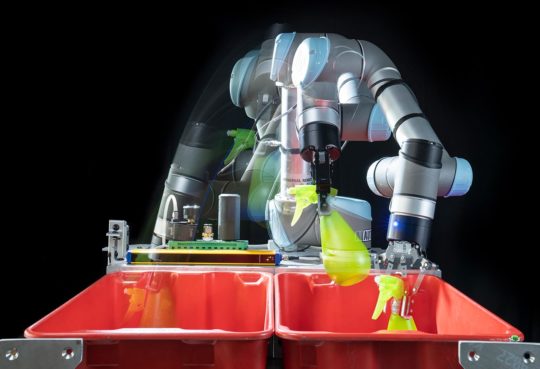
UR-5 robot performs a grasping motion.

A UR-5 robot performs a grasping motion in an experiment led by postdoctoral researcher Jeff Ichnowski. (Photo by Adam Lau)

But a solution may be at hand. A research team led by Ken Goldberg, professor of industrial engineering and operations research and of electrical engineering and computer sciences, has developed artificial intelligence software that allows robotic arms to quickly grasp and move objects in a smooth and steady motion.

Previously, Goldberg and postdoctoral researcher Jeffrey Ichnowski had created a grasp-optimized motion planner that computed the most efficient way for robots to handle and move objects, but when they modified the software to smooth out the motions, it significantly slowed everything down, making the system impractical.

To address this challenge, the research team — including graduate student Yahav Avigal and undergraduate student Vishal Satish — combined a deep learning network with the motion planner. After sampling thousands of motions that a robot would likely make, they used them to train the deep learning network, which then proposed trajectories of varying lengths and selected the optimal one. The motion planner used that information to identify the best starting point for planning the smoothest trajectory to use. This integration proved to be key, allowing the team to cut the average computation time from 29 seconds to 80 milliseconds, or less than one-tenth of a second.

The researchers hope to expand this work to other robotic tasks in complex environments, as well as test new approaches to further speed up the deep learning process.

Learn more: Deep learning can accelerate grasp-optimized motion planning (Science Robotics)

Topics: AI & robotics, Industrial engineering
  • Contact
  • Give
  • Privacy
  • UC Berkeley
  • Accessibility
  • Nondiscrimination
  • instagram
  • X logo
  • linkedin
  • facebook
  • youtube
  • bluesky
© 2025 UC Regents