• Skip to main content
  • Skip to primary navigation
  • Departments
    • Bioengineering
    • Civil and Environmental Engineering
    • Electrical Engineering and Computer Sciences
    • Industrial Engineering and Operations Research
    • Materials Science and Engineering
    • Mechanical Engineering
    • Nuclear Engineering
    • Aerospace program
    • Engineering Science program
  • News
    • Berkeley Engineer magazine
    • Social media
    • News videos
    • News digest (email)
    • Press kit
  • Events
    • Events calendar
    • Commencement
    • Homecoming
    • Cal Day
    • Space reservations
    • View from the Top
    • Kuh Lecture Series
    • Minner Lecture
  • College directory
  • For staff & faculty
Berkeley Engineering

Berkeley Engineering

Educating leaders. Creating knowledge. Serving society.

  • About
    • Facts & figures
    • Rankings
    • Mission & values
    • Equity & inclusion
    • Voices of Berkeley Engineering
    • Leadership team
    • Milestones
    • Buildings & facilities
    • Maps
  • Admissions
    • Undergraduate admissions
    • Graduate admissions
    • New students
    • Visit
    • Maps
    • Admissions events
    • K-12 outreach
  • Academics
    • Undergraduate programs
    • Majors & minors
    • Undergraduate Guide
    • Graduate programs
    • Graduate Guide
    • Innovation & entrepreneurship
    • Kresge Engineering Library
    • International programs
    • Executive education
  • Students
    • New students
    • Advising & counseling
    • ESS programs
    • CAEE academic support
    • Grad student services
    • Student life
    • Wellness & inclusion
    • Undergraduate Guide
    • > Degree requirements
    • > Policies & procedures
    • Forms & petitions
    • Resources
  • Research & faculty
    • Centers & institutes
    • Undergrad research
    • Faculty
    • Sustainability and resiliency
  • Connect
    • Alumni
    • Industry
    • Give
    • Stay in touch
Home > News

News

Keeping in touch with the times

09/04/09 — Communicating with you-our alumni, our supporters, our friends-is one of our most important priorities. We want you to know what's going on at Berkeley Engineering and we want to hear back from you. It is through your good works and your good will that the college stays strong and spreads word of its excellence in teaching, in research and in all its endeavors.

Brain–Machine Interface Holds Promise for Prosthetics

09/04/09 — "Practice makes perfect" is the maxim drummed into anyone struggling to learn a new motor skill, be it riding a bike or developing a killer backhand in tennis. New research by UC Berkeley assistant professor of electrical engineering and computer sciences Jose Carmena and colleagues now reveals that the brain can also achieve this motor memory with a disembodied device. The study provides hope that physically disabled people could one day master control of artificial limbs with greater ease.

One of BART’s Biggest Fans

09/04/09 — Barney Smits (B.S.'92 ME) rides Bay Area Rapid Transit every weekday from his Oakland home to his office, two blocks from Oakland's 19th St. station. "I take it just about everywhere I can," he says. "To the opera in the city, to the airport when I'm traveling. Once you're used to it, it's the absolute best, easiest way of getting around." But then he might be biased. Smits, 53, is the transit system's principal mechanical engineer, a job he's held for several years. He's one of the guys who makes sure that the 20 miles of tunnel and 208 miles of track and all the stations and system facilities are safe for riders like him, and you.
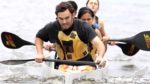
Concrete canoe team during a race

Heavyweight Champs

09/04/09 — In the world of quirky contests, the U.S. National Concrete Canoe Competition isn't as far-out as, say, the Extreme Ironing World Championships or as appalling as the World Bog Snorkeling Championships, but it has its own ability to astound the public and lure fanatical participants. As devoted undertakings go, it is a little silly and a lot serious, especially here at Berkeley Engineering, where a team of 25 civil engineers won the national championship this summer, their first since 1992.

The Many Faces of Engineering

08/03/09 — What do you see when you think engineer? Our non-engineering colleagues might envision a middle-aged man at a construction site, sporting a hardhat and poring over a set of plans. But we know that engineering has exploded in recent years due to globalization, the IT and biotech booms, clean energy and a host of other factors. As Lawrence Fisher reports in our spring Forefront ("Engineering evolved"), the field today is so broadly multidisciplinary that new applications require the talents of everyone from "software savants and materials mavens" to "aerospace adepts."

Listening to the Price of Power: New Thermostats Could Save Billions

08/03/09 — A new generation of inexpensive programmable thermostats with the capacity to communicate may provide a simple and versatile tool for addressing California's complex, billion-dollar summer peak energy demand problems. Engineering professor David Auslander - working with utility companies, engineers and policy wonks - has created a new set of design rules for the programmable communicating thermostat (PCT) that could help pave the way for greater energy efficiency in homes. Energy specialists have long known that programmable thermostats (PTs) have the potential to save homeowners money, reduce the need for new power plants and shrink the amount of pollutants and climate-altering carbon dioxide pumped into the atmosphere. But unfortunately, fewer than 20 percent of Californians take the time to program their thermostats.

Boarding School: Scientist on Wheels

08/03/09 — Daryl Chrzan, a noted researcher in the field of computational materials science, is a diehard skateboarder. Besides carving the bowls at local skate parks, Chrzan loves to think about the science behind the sport. The Berkeley professor of materials science and engineering considers such questions as the physics involved in stunts, the evolution of the skateboard wheel, the limits of a skateboard's strength and even the g-forces experienced in spectacular spills. For the past two years, Chrzan has posed-and tried to answer-those puzzles in a one-unit freshman seminar called Physics and Materials Science of Skateboarding. His hands-on class puts a new spin on a popular, if educationally unsung pastime.

What’s Ahead for Our Graduates?

06/04/09 — “If you haven't gotten the ideal job yet, don't take any job! Be bold and creative: take a year off. Look for great leadership development opportunities. Become a volunteer math or science teacher in underserved communities in America or in poor villages in Africa, South America or Asia.”

Nanoneedles Point the Way to Sharper Sensors

06/04/09 — Last year, Connie Chang-Hasnain and graduate student researcher Linus Chuang were searching for a better lab recipe for growing nanowires, conductive threads so thin that every atom they contain has a significant effect on their overall electrical properties. Following the vapor-liquid-solid (VLS) technique for creating semiconductor crystal nanowires, they deposited successive layers of gallium arsenide onto a silicon wafer substrate. But in one low-temperature batch, an area of the silicon lacked the usual gold nanoparticles from which each crystal grows. Under careful examination of the region, they didn't find what they were expecting. Instead of uniform-diameter threads sticking up, they saw tall, needle-like pyramids with hexagonal bases and sharp points. They had discovered a new nanostructure.

A Breath of Fresh Air

06/04/09 — We spend up to 90 percent of our time indoors but probably don't give much thought to the quality of the air we breathe until we step outside. That could be a mistake, says Beverly Coleman (M.S.'05, Ph.D.'09 CEE), who received her doctorate just last month.

Nano Song Goes Viral

06/04/09 — A music video that playfully celebrates all things nano has become a megahit for three Berkeley Engineering graduate students and their Cal team.

Women Find a Home at Berkeley Engineering

05/02/09 — From Monica Tanza, a mechanical engineering senior interested in sustainable design, to Cagla Meral, a civil and environmental engineering Ph.D. student working on greener cement, women are pursuing their ambitions at Berkeley Engineering.

Drug Delivery, Nanoscale

05/02/09 — Roughly the size of a matchstick, a slender titanium tube could become a pint-sized weapon against chronic hepatitis C and a host of other debilitating diseases. Three UCSF/UC Berkeley doctoral students are designing a tiny implantable device capable of delivering steady and minute quantities of potent drugs into the bloodstream. The Nano Precision Pump could reduce serious side effects caused by injections of far larger doses of medicine-improving patient quality of life, compliance and cure rates, the students say.

A Fix for Memorial Stadium

05/02/09 — If the Hayward Fault ruptures during a Cal home game, Memorial Stadium fans would be in for a wild ride. But they should be safe-even if they're seated in the most vulnerable end-zone sections. That's the outcome that David Friedman (B.S'75 CE) envisions for the massive retrofit of UC Berkeley's landmark but seismically poor football venue. Friedman, senior principal at San Francisco–based Forell/Elsesser Engineers, is the lead engineer for the stadium's renovation. Built in 1923, Memorial Stadium straddles the Hayward Fault and is in need of seismic upgrades.

Engineering Better Disaster Relief

05/02/09 — Scheduling problems, which involve searching for an optimal or near-optimal schedule for a set of tasks, are notoriously complex because simple searches are overwhelmed by their explosively vast number of possibilities. But with large-scale manufacturing and distribution operations, fractional improvements in scheduling can have large-scale impacts on the bottom line, which is why industrial engineers are routinely called upon to create customized sophisticated strategies for specific scheduling problems. Now, Professor Rhonda Righter has applied industrial engineering–style analysis to a different type of scheduling problem: after a mass casualty event, such as a natural disaster, a wreck or an attack, how should a medical emergency response team allocate its attention to patients, in order to save the most lives?

Can Personal Privacy Coexist with National Security?

03/02/09 — The urgent business of protecting the American people from terrorism and other threats will almost certainly follow a different course under the Obama administration. In particular, the security of electronic information supporting our most critical systems – for instance, financial, medical and civil infrastructure data – is likely to be defined by a stronger effort to reconcile the competing needs of public security, personal privacy and utility.

The Ozone Weekend Effect

03/02/09 — A large part of gasoline and diesel engine pollution consists of two components: soot and nitrogen oxides, or NOx. Soot is made up of tiny carbon particles that hang in the air and dirty it, but NOx, a mix of nitric oxide and nitrogen dioxide, has a more complicated story. NOx feeds chemical pathways that are fueled by sunlight and produce the noxious brew we call smog. In general, reducing NOx tailpipe emissions reduces this pollution. But, as CEE professor Robert Harley has found, there is an exception to this rule, known as the ozone weekend effect, that can confound air quality management efforts unless it is understood.

From Bacon to Biofuel

03/02/09 — Brown grease - a nasty melange of leftover animal fat, pan scrapings and other gunky residue - is a sewer pipe's worst enemy. In San Francisco, a pilot project led by two Berkeley Engineering alumni is in the works to explore for the first time how wastewater treatment plants throughout California might turn the unappealing stuff into biodiesel fuel. "For the city, it's going to be a win-win situation," says Domenec Jolis (Ph.D.'92 CEE), a senior engineer at the San Francisco Public Utilities Commission and the project's co-principal investigator.

Revving up the Internal Combustion Engine

03/02/09 — In the quest for smarter cars of the future, Hunter Mack (M.S.'04, Ph.D.'07 ME) is putting a new spin on the internal combustion engine. Mack's focus as a postdoctoral researcher at Berkeley Engineering is an innovative system called HCCI that behaves like a cross between a gas and a diesel engine. HCCI, shorthand for homogeneous charge compression ignition, delivers up to 30 percent better fuel economy than gas engines, emits far fewer emissions than a typical diesel and isn't fussy about what's pumped in its tank. And because HCCI is a modification of a conventional engine, the system as a whole or elements of it could be installed in new cars within 5 to 10 years.

An Invitation – and a Charge

02/02/09 — As we listened to President Obama's inaugural address on January 20, we were encouraged by his remarks emphasizing the role of science. However, the nation's research community would be shortsighted to take these words simply as an invitation to submit funding requests and expand programs. Instead, we must mobilize quickly to identify the most ambitious challenges we are capable of tackling-in other words, our “moon shots” for the 21st century.
  • « Go to Previous Page
  • Go to page 1
  • Interim pages omitted …
  • Go to page 139
  • Go to page 140
  • Go to page 141
  • Go to page 142
  • Go to page 143
  • Go to page 144
  • Go to Next Page »
  • Contact
  • Give
  • Privacy
  • UC Berkeley
  • Accessibility
  • Nondiscrimination
  • instagram
  • X logo
  • linkedin
  • facebook
  • youtube
  • bluesky
© 2026 UC Regents