• Skip to main content
  • Skip to primary navigation
  • Departments
    • Bioengineering
    • Civil and Environmental Engineering
    • Electrical Engineering and Computer Sciences
    • Industrial Engineering and Operations Research
    • Materials Science and Engineering
    • Mechanical Engineering
    • Nuclear Engineering
    • Aerospace program
    • Engineering Science program
  • News
    • Berkeley Engineer magazine
    • Social media
    • News videos
    • News digest (email)
    • Press kit
  • Events
    • Events calendar
    • Commencement
    • Homecoming
    • Cal Day
    • Space reservations
    • View from the Top
    • Kuh Lecture Series
    • Minner Lecture
  • College directory
  • For staff & faculty
Berkeley Engineering

Educating leaders. Creating knowledge. Serving society.

  • About
    • Facts & figures
    • Rankings
    • Mission & values
    • Equity & inclusion
    • Voices of Berkeley Engineering
    • Leadership team
    • Milestones
    • Buildings & facilities
    • Maps
  • Admissions
    • Undergraduate admissions
    • Graduate admissions
    • New students
    • Visit
    • Maps
    • Admissions events
    • K-12 outreach
  • Academics
    • Undergraduate programs
    • Majors & minors
    • Undergraduate Guide
    • Graduate programs
    • Graduate Guide
    • Innovation & entrepreneurship
    • Kresge Engineering Library
    • International programs
    • Executive education
  • Students
    • New students
    • Advising & counseling
    • ESS programs
    • CAEE academic support
    • Grad student services
    • Student life
    • Wellness & inclusion
    • Undergraduate Guide
    • > Degree requirements
    • > Policies & procedures
    • Forms & petitions
    • Resources
  • Research & faculty
    • Centers & institutes
    • Undergrad research
    • Faculty
    • Sustainability and resiliency
  • Connect
    • Alumni
    • Industry
    • Give
    • Stay in touch
Home > News > Ready to roll
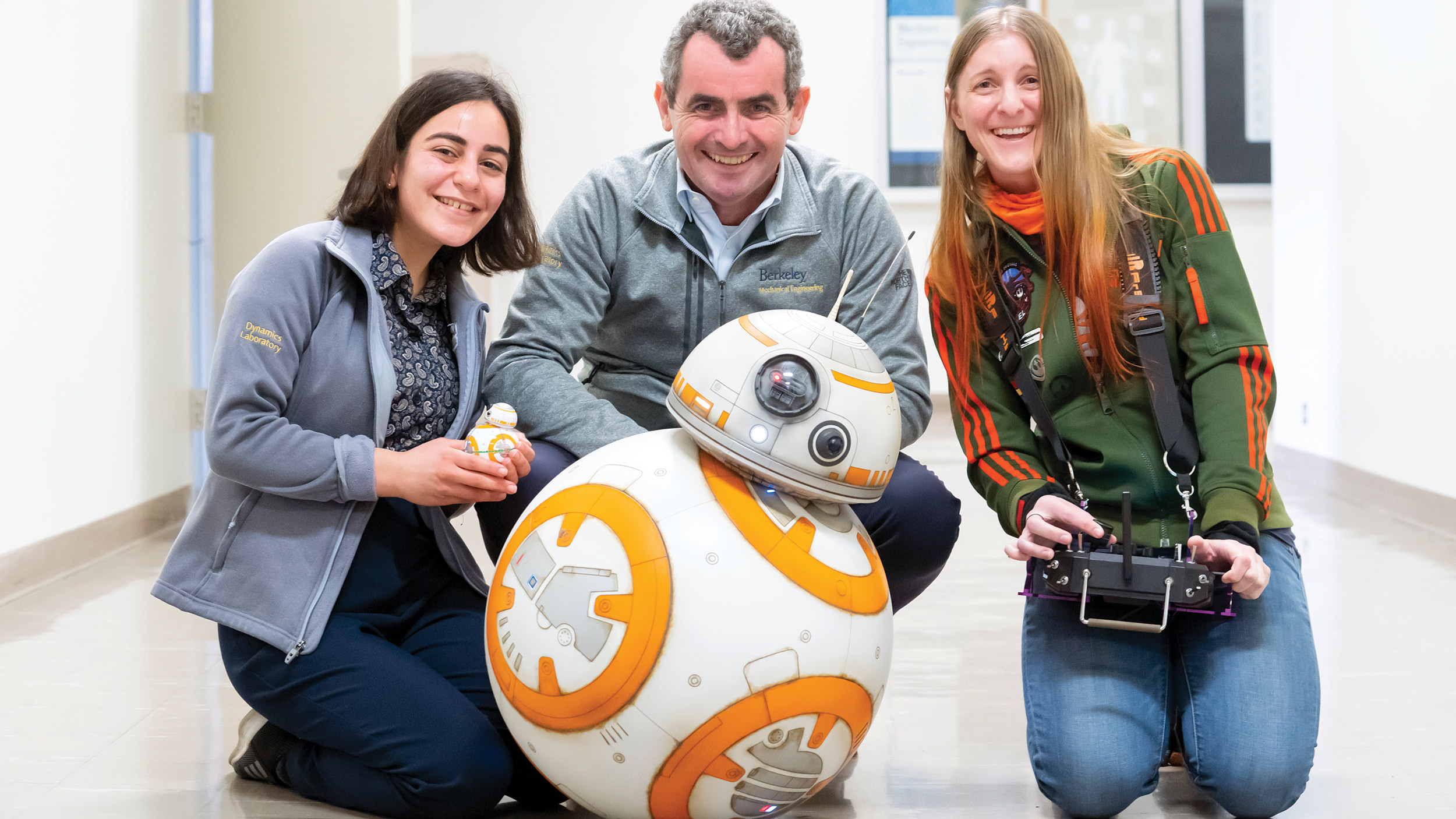
Oliver O’Reilly, Theresa Honein, Jessica "Psy" DeLacy and a replica BB-8 robot.Mechanical engineering professor Oliver O’Reilly with Ph.D. student Theresa Honein, guest lecturer Jessica "Psy" DeLacy and a replica BB-8 robot. (Photo by Adam Lau/Berkeley Engineering)

Ready to roll

Berkeley Engineer magazine, Spring 2024
May 31, 2024
This article appeared in Berkeley Engineer magazine, Summer 2024
  • In this issue
    EECS professor Boubacar Kanté in his Cory Hall laser lab

    Light science

    Impressionistic illustration in cool blues and greys

    Cool it down

    Dancer, roboticist and mechanical engineer Catie Cuan flails her arms, mimicking the movements of a UR5e robot arm, in the performance piece "Breathless."

    Bridging the brain

    Nobel-prize winning professor Jennifer Doudna meets with Society of Women Engineers students before the Kuh Distinguished Lecture

    Building on strength

    Upfront

    • Putting on the heat
    • New Berkeley Space Center
    • Grand designs
    • Ready to roll
    • So to speak
    • Going big with nano
    • Q+A on solar sails

    New & noteworthy

    • A new paradigm
    • Three professors elected to NAE
    • Farewell
    • Support Berkeley Engineering
    • All charged up
  • Past issues

BB-8 of Star Wars fame is known for its adorable beeps, dome-shaped head and spherical body. But fighting alongside the Resistance is just one of its many talents. As this spherical robot rolls across surfaces, it’s exhibiting holonomy, a phenomenon in rigid body dynamics that Berkeley researchers think may have broad applications in real-life robotics. Now, Ph.D. student Theresa Honein and mechanical engineering professor Oliver O’Reilly have calculated all the possible changes in the orientation of a rolling sphere in a quest to better understand holonomy.

What is holonomy? “Imagine a tennis ball rolling in a closed path, on a tabletop, so that the center of the ball returns to its original location. Surprisingly, the orientation of the ball will have changed, as you’ll notice by looking at the branding markings on the ball,” said O’Reilly. “This same phenomenon is exhibited by BB-8. As the robot moves around a room and returns to its original location, the orientation of its spherical part will have changed, albeit camouflaged by the ingenious magnetic mechanism used to orient its head.”

In the study, the researchers showed that a sphere tracing a closed path returns to its original position but not always to its original orientation. They also showed that any rotation of a sphere (in three dimensions) can be achieved by tracing rectangles in the plane — and presented dimensions of three rectangles that should be traced consecutively to obtain a desired change in orientation of the sphere.

“The surprising result was that we showed how any change in the orientation of a sphere [in three dimensions] can be achieved by tracing three interlocked rectangles on the plane,” said Honein. “This finding used one of three methods for describing rotations developed by the famous mathematician Leonhard Euler in the 18th century.”

Their findings may lead to new strategies for achieving more efficient navigation with spherical robots, as well as real-world applications in surveillance, environmental monitoring, and underwater and planetary exploration.

Learn more: Researchers explore the phenomenon of holomony; Explorations of the holomony of a rolling sphere (Proceedings of the Royal Society A)

Topics: Mechanical engineering, AI & robotics, Faculty, Research
  • Contact
  • Give
  • Privacy
  • UC Berkeley
  • Accessibility
  • Nondiscrimination
  • instagram
  • X logo
  • linkedin
  • facebook
  • youtube
  • bluesky
© 2025 UC Regents