• Skip to main content
  • Skip to primary navigation
  • Departments
    • Bioengineering
    • Civil and Environmental Engineering
    • Electrical Engineering and Computer Sciences
    • Industrial Engineering and Operations Research
    • Materials Science and Engineering
    • Mechanical Engineering
    • Nuclear Engineering
    • Aerospace program
    • Engineering Science program
  • News
    • Berkeley Engineer magazine
    • Social media
    • News videos
    • News digest (email)
    • Press kit
  • Events
    • Events calendar
    • Commencement
    • Homecoming
    • Cal Day
    • Space reservations
    • View from the Top
    • Kuh Lecture Series
    • Minner Lecture
  • College directory
  • For staff & faculty
Berkeley Engineering

Educating leaders. Creating knowledge. Serving society.

  • About
    • Facts & figures
    • Rankings
    • Mission & values
    • Equity & inclusion
    • Voices of Berkeley Engineering
    • Leadership team
    • Milestones
    • Buildings & facilities
    • Maps
  • Admissions
    • Undergraduate admissions
    • Graduate admissions
    • New students
    • Visit
    • Maps
    • Admissions events
    • K-12 outreach
  • Academics
    • Undergraduate programs
    • Majors & minors
    • Undergraduate Guide
    • Graduate programs
    • Graduate Guide
    • Innovation & entrepreneurship
    • Kresge Engineering Library
    • International programs
    • Executive education
  • Students
    • New students
    • Advising & counseling
    • ESS programs
    • CAEE academic support
    • Grad student services
    • Student life
    • Wellness & inclusion
    • Undergraduate Guide
    • > Degree requirements
    • > Policies & procedures
    • Forms & petitions
    • Resources
  • Research & faculty
    • Centers & institutes
    • Undergrad research
    • Faculty
    • Sustainability and resiliency
  • Connect
    • Alumni
    • Industry
    • Give
    • Stay in touch
Home > News > Bridging the brain
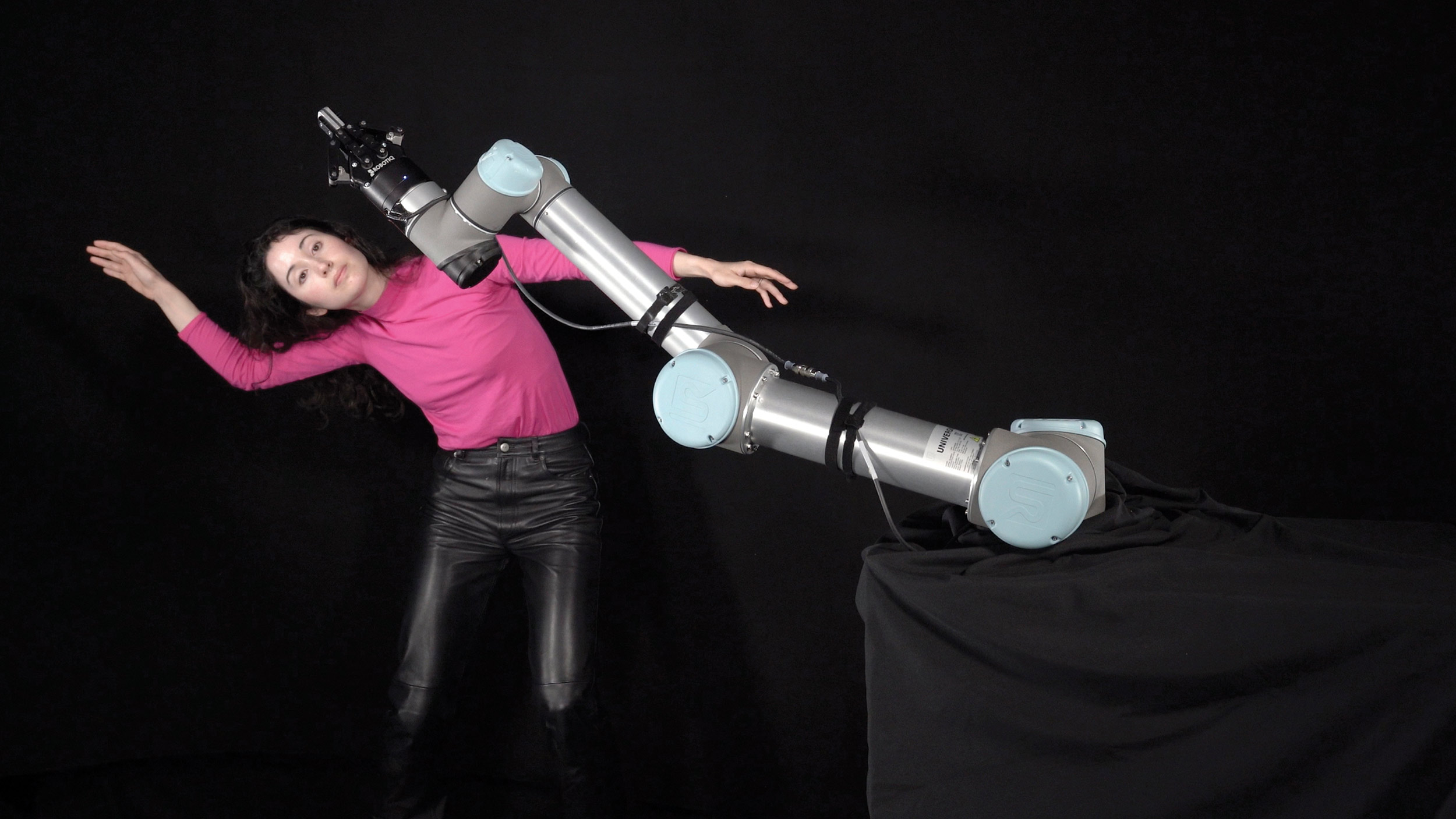
Dancer, roboticist and mechanical engineer Catie Cuan flails her arms, mimicking the movements of a UR5e robot arm, in the performance piece "Breathless."Dancer, roboticist and mechanical engineer Catie Cuan and a UR5e robot arm. (Photo by Adam Lau/Berkeley Engineering)

Bridging the brain

Berkeley Engineer magazine, Spring 2024
May 31, 2024 by Caitlin Kelley | Photo by Adam Lau
This article appeared in Berkeley Engineer magazine, Summer 2024
  • In this issue
    EECS professor Boubacar Kanté in his Cory Hall laser lab

    Light science

    Impressionistic illustration in cool blues and greys

    Cool it down

    Dancer, roboticist and mechanical engineer Catie Cuan flails her arms, mimicking the movements of a UR5e robot arm, in the performance piece "Breathless."

    Bridging the brain

    Nobel-prize winning professor Jennifer Doudna meets with Society of Women Engineers students before the Kuh Distinguished Lecture

    Building on strength

    Upfront

    • Putting on the heat
    • New Berkeley Space Center
    • Grand designs
    • Ready to roll
    • So to speak
    • Going big with nano
    • Q+A on solar sails

    New & noteworthy

    • A new paradigm
    • Three professors elected to NAE
    • Farewell
    • Support Berkeley Engineering
    • All charged up
  • Past issues

In the performance piece “Breathless,” a UR5e robot arm flails wildly back and forth, as dancer and roboticist Catie Cuan arches her full body to mimic its movements. The unnatural effect of the robot’s motion becomes that much more heightened when paired with the human body. But Cuan never offers a 1:1 copy; the eight-hour piece aims to spark conversation about the relationship between artificial intelligence and the future of human labor.

So it’s fitting that she gave a presentation on this collaboration with Ken Goldberg, professor of industrial engineering and operations research and of electrical engineering and computer sciences, in the latter’s class, Beyond the Uncanny Valley: Art, AI and Robotics.

A science fiction staple, the “uncanny valley” theory posits that as robots acquire more human-like features, they become more likable — until they don’t. That “valley” was charted by Japanese roboticist Masahiro Mori in 1970 to describe the frightening sensation of observing objects that are too human-like.

The course, co-led by Lisa Wymore — professor of theater, dance and performance studies — seeks to offer historical context to bridge the artistic and technical understanding of technological advancements in the wake of the AI explosion. The syllabus covers everything from dance to deepfakes, with plenty of insights from guests working at OpenAI, Niantic and the Department of Art.

“I was really interested in teaching students about the history of ‘uncanny’ that predates the ‘uncanny valley,’” Goldberg said. “I would say most engineers don’t know that background.”

On the flip side, Goldberg also intends to provide context to humanities majors who “don’t know the history of AI.”

This left brain-right brain approach is seeded into the class structure. One minute, students can hear graduate student instructor Curtis Rumrill of the music department unpack his unsettling composition on the violent lifespan of a farmed rabbit. The next, graduate student instructor Simeon Adebola of the AUTOLab might explain in detail how machine learning helps robots move.

Goldberg sees this interdisciplinary format as a reflection of the zeitgeist. “These fields are starting to come together in interesting ways,” he said. “That’s really exciting, because it brings together viewpoints. It’s intellectual diversity. Engineers think a little differently than English majors.”

Topics: AI & robotics, College news, Faculty, Students
  • Contact
  • Give
  • Privacy
  • UC Berkeley
  • Accessibility
  • Nondiscrimination
  • instagram
  • X logo
  • linkedin
  • facebook
  • youtube
  • bluesky
© 2025 UC Regents